After our Irish detour, we are back in Scotland, and more specifically in one of the country’s most obsessively followed distilleries: Springbank. This tasting brings together four 15-year-olds – an older bottle from 2006 and the 2024, 2025 and 2026 releases – for a simple but revealing exercise in batch variation, with the aim of seeing how much the same age statement can shift over time while still remaining recognisably Springbank.
That kind of comparison is exactly where Springbank tends to reward attention. Even when the age statement stays fixed, the cask mix, batch composition and bottling conditions can subtly reshape the whisky from one release to the next, so lining up an older bottling against three recent ones should tell us a lot about continuity and drift, and perhaps even about what we really mean when we say a whisky is ‘the same’ from year to year. When the Local Barley has age, cask and farm variation, the Springbank 15-year-old shows stability.
Batch Variation
Batch variation in whisky is the natural fact that two bottles of the same named whisky can taste slightly different from one another, even when the label, age statement, and ABV are the same. It happens because whisky is made from individual casks (and those casks can be vatted together), and no two casks age in exactly the same way: wood, warehouse position, climate (which has an impact on the angel’s share), and bottling decisions all have an effect.
A distillery or bottler usually vattings or marries multiple casks to make a consistent batch, but each cask still brings its own personality. Small differences in cask type, fill level, previous use, warehouse conditions, and even minor production changes over time can shift the result from one batch to the next.
Batch variation can show up as a whisky being a little fruitier, woodier, drier, sweeter, more sherried, more peppery, or simply less intense than the bottle you had before. It is usually more visible in whiskies that are batch-bottled, cask strength, or bottled with less filtration, and especially in single malts, where the cask mix can change noticeably from release to release.
For drinkers, batch variation is both a challenge and part of the appeal: it explains why you may love one bottling of a whisky and find the next slightly different, without either being ‘wrong’. For reviewers, it is one reason to note batch codes, bottling dates, and cask details whenever possible, especially if you want later comparisons to make sense.
And that’s what we’ll be doing right now, with an older batch of Springbank 15-year-old first, but mostly with three recent batches, from 2024, 2025 and 2026.
Springbank 15-Year-Old (+/- 2006) Review
This bottling represents one of the early releases of the ‘modern era’ Springbank 15 Years Old, using a label style confirmed by Whiskybase to have been in circulation between 2006 and 2008 on full-sized bottles. It arrived roughly 15 years after Springbank distillery’s early-1990s reopening, making this generation of 15-year-old bottlings among the first to draw entirely on stock laid down after the modern revival. As with all Springbank releases, the whisky is distilled at the family-owned J&A Mitchell & Co. distillery in Campbeltown, using a distinctive two-and-a-half times distillation process and light peating. This particular expression is matured 100% in ex-sherry casks, a departure from the 10-year-old’s bourbon-sherry split and, at the time, one of the more heavily sherry-dominant releases in the core range.
Bottled at 46% ABV, it was already non-chill-filtered and with no added colouring.
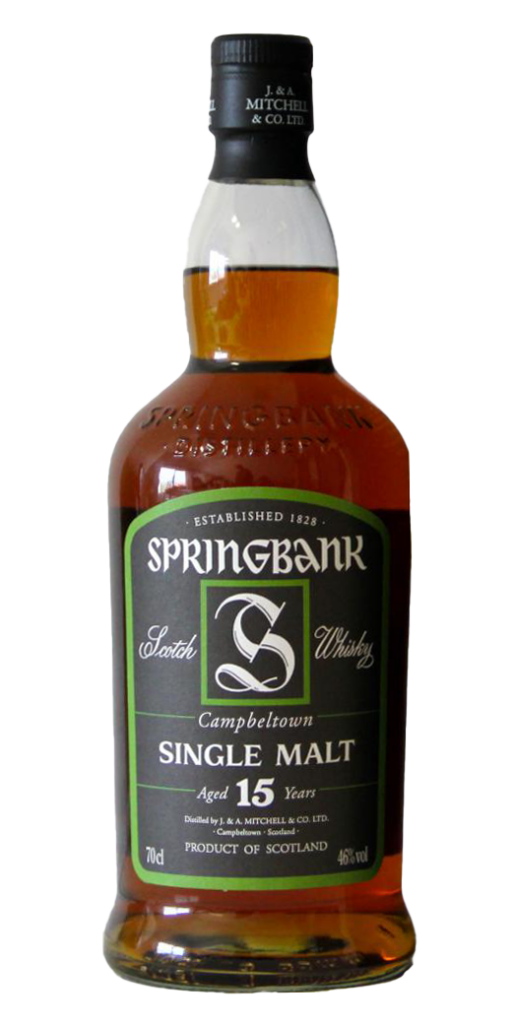
Colour:
Deep gold (lighter than on the picture).
Nose:
Neat: Dried apricot, mirabelle plum and vanilla, with a fleeting note of perfumed soap that fades to reveal a mineral quality and intensifying peat smoke, joined by herbal notes of chervil, marjoram, and tarragon, sea salt, and allspice, developing an increasingly maritime character. Fresh-cut flowers, salty sea spray, and warm engine oil alongside toffee and honey.
Palate:
Neat: The palate shows an oily, creamy mouthfeel carrying herbaceous wood, lavender and violet candy, apricot kernels, milk chocolate, and salt and pepper, with a pleasing minerality present from the first sip before drying wood notes settle in. These are joined by tart herbs, dried apricot, lime zest, and dry, bitter wood, with the machine-oil note carried from the nose.
Finish:
The finish is medium in length, mineral and maritime with a hint of pepper and lingering fruit and wood notes.
Comments:
This Springbank 15-year-old is a little strange, as it shows an unusual sweet and floral character on the nose and palate, and not much of the sherry notes you could expect from its maturation. The sweetness is slightly too present and unbalanced, but the distillery hadn’t been restarted for long, so they might have needed more tweaks at the time to reach their desired profile.
Rating: 6/10
Springbank 15-Year-Old (2024) Review
Next, we have the 2024 release of Springbank’s core 15-year-old expression, matured entirely in Oloroso sherry casks and bottled at 46% ABV, non-chill-filtered, natural colour. Springbank switched to this green and black label around 2017, and this is still the one used at this time. There seem to have been four batches bottled in 2024, on the 15th of February, the 3rd of June, the 15th of August and the 14th of November 2024, and it’s the latter we’re tasting. Released at £75, you’ll have to pay probably close to €140 to get a bottle.
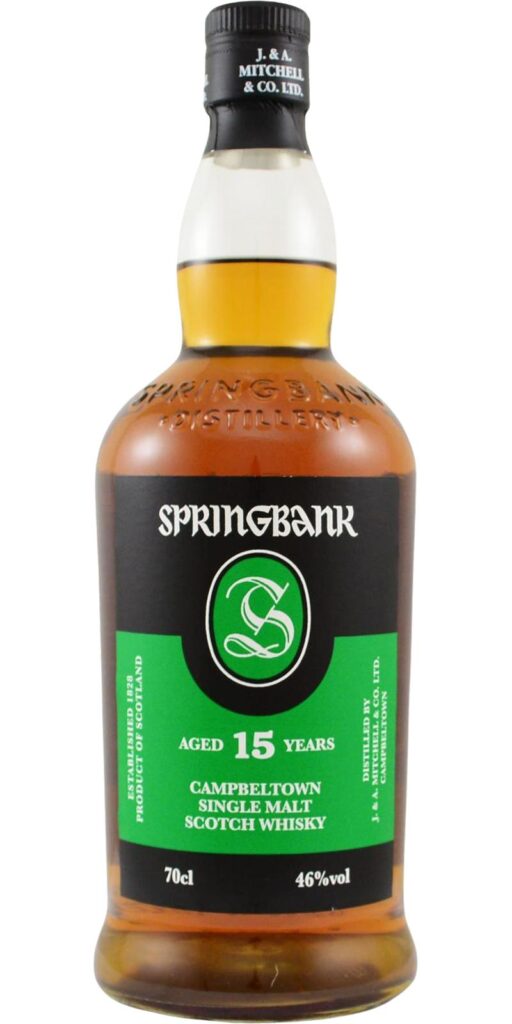
Colour:
Clay.
Nose:
Neat: Dried figs, raisins, and overripe grapes lead, alongside nougat, marzipan, and salted almonds, with a lovely, indefinable spiciness running through the fruit. Salty sea spray, beach grass, and warm machine oil add Springbank’s signature maritime-industrial edge, intensifying the longer the whisky sits in the glass, eventually revealing roasted orange peel.
Palate:
Neat: Full-bodied and rich, with dried figs, dates, raisins, blackcurrants, elderberry syrup, and red grapes, developing marzipan bread, pecan nuts, and sugar beet syrup. Old leather, tobacco, and hazelnut praline, with a sliver of diesel adding an industrial element and the orange-y nose note returning on the palate. And no trace of sulfur!
Finish:
Mong finish with pepper, mentholated coolness, dark soy sauce, wood smoke, and bitter chocolate, cola cubes, tobacco, smoky vanilla, and baked fruit.
Comments:
Excellent Springbank 15-year-old, and a demonstration that this less-liked expression from Springbank’s core range still deserves some love. This one is a great sherried Springbank, especially since, for once, it does not show any trace of sulfur, which you can often find in sherried Springbanks.
Rating: 7.5/10
Springbank 15-Year-Old (2025) Review
Next, we have the 2025 release of Springbank’s core 15-year-old, again matured entirely in ex-sherry casks, natural colour, non-chill-filtered, at 46% ABV. Only two batches have been listed on Whiskybase, bottled on the 7th of February and the 17th of September 2025, and we’re tasting the February batch (bottle code 25/26), so it was bottled just shy of three months after the one above. Released at £75, you’ll have to pay probably close to €140 to get a bottle.
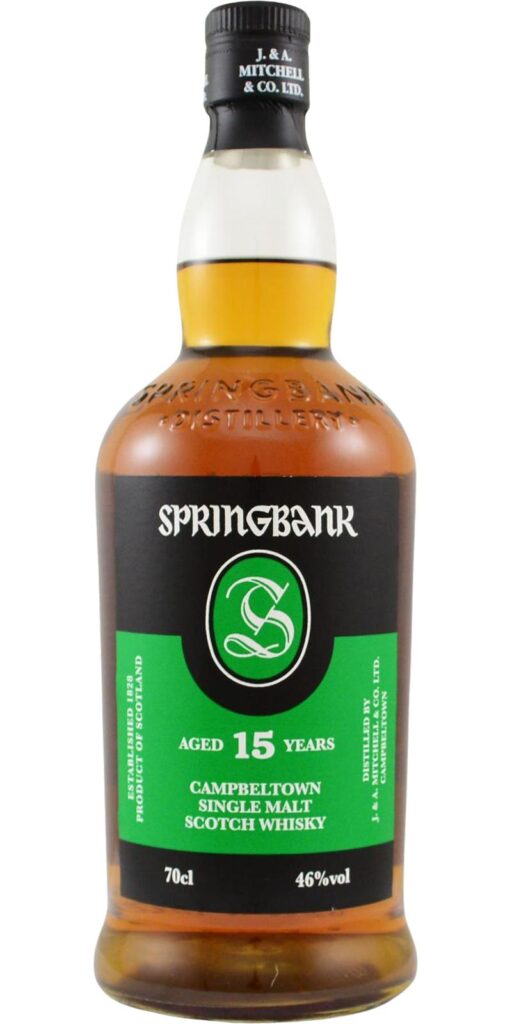
Colour:
Spice.
Nose:
Neat: Very fruity, dense, syrupy, marmalade-like richness packed with berries: raspberries, strawberries, and blackcurrants. Demerara sugar, dark chocolate, almonds, toffee, cured meat, clove, mint, iodine, and tinned prunes – hallmarks of Oloroso cask maturation combined with Springbank’s characteristic maritime character.
Palate:
Neat: Creamy, with raisins, dark chocolate, figs, marzipan, Brazil nuts, and vanilla. The peaty character is evident, with sooty kiln smoke and tobacco prominent. The palate has a viscous mouthfeel, and also features prunes, walnuts, figs, Demerara sugar, cocoa powder, and smoked meats. This feels like it leans mostly towards first-fill sherry.
Finish:
Growing and developing, with soot, leather, and walnuts prominent before easing off gently.
Comments:
The nose is slightly rounder, richer and deeper than the 2024 release. The palate almost feels like a sherry bomb, but this is still fundamentally well balanced. A slightly different profile than the 2024 release, showing definite batch variation, but also clear similarities and proximity.
Rating: 7.5/10
Springbank 15-Year-Old (2026) Review
This is the 2026 release of Springbank’s core 15-year-old expression, bottled on 15 April 2026 (only batch for now it seems, bottle code 26/59), matured entirely in sherry casks, non-chill-filtered and with natural colour, and again reduced to 46% ABV. Released at £75, you’ll have to pay probably close to €140 to get a bottle (the recommended retail price for France is theoretically €106–109, but, yet again, it will probably cost you quite more).
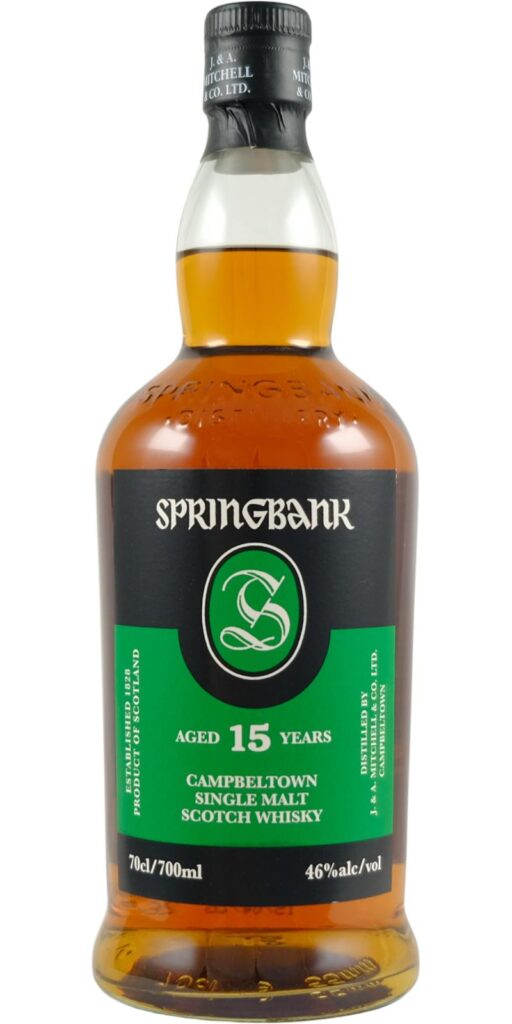
Colour:
Chestnut.
Nose:
Neat: The nose opens on oriental spices with a hint of Indian curry and red pepper, before moving into a fruit bowl. Strong hints of blood orange , grapefruit and lemon, joined by red fruits. There is also a scented limestone minerality. The sherry casks provide Demerara sugar, dark chocolate, Christmas cake, almonds, toffee, and oak, for a nose clearly less sherried than the previous two expressions.
Palate:
Neat: The palate shows smoky wood flavours, dark chocolate, and cacao powder, with hints of cold brew coffee carrying a bourbon-like note. The mouthfeel is creamy, and the palate also shows raisins, figs, marzipan, and a lighter profile than the 2024 and 2025 editions: it feels less sherried.
Finish:
The finish is long, with Indian spices from the nose, bright fruits, and lots of limestone minerality with a whisper of smoke.
Comments:
The colour of this 2026 edition of Springbank 15-year-old is clearly lighter than the previous two expressions, with several shades lighter. And this lighter feeling translates to the tasting itself, with an edition feeling less sherried than the 2024 and 2025 ones. Did Springbank use more refill sherry casks than on the previous editions? In any case, another very good whisky, maybe even slightly better for me.
Rating: 8/10
Final Comments
Despite the strong similarities between these four Springbank 15-year-old, and, obviously, mostly between the 2024, 2025 and 2026 editions, they’re a demonstration of what batch variation is, even when the recipe does not seem to change. There are clear differences but also strong similarities between these three recent batches, showing that, despite Springbank seemingly looking for something similar, they allow the differences to exist.
What a great set of reviews, and the compare and contrast of the recent releases. Very helpful for everyone!