What happens inside a whisky cask, why older doesn’t necessarily mean better, and why time is only one ingredient in maturation.
Whisky enthusiasts have a complicated relationship with age. We know perfectly well that a 12-year-old whisky can be outstanding, that a 30-year-old can be disappointing, and that some young whiskies are considerably more interesting than bottles costing ten times as much. Yet put a 40-year-old age statement on a label and most of us will suddenly become very interested.
And I include myself in that observation.
Age statements have an undeniable appeal. They promise rarity, patience and a connection to the past. A whisky distilled decades ago has spent years quietly evolving while the world around it has changed, and there’s something rather wonderful about finally opening it.
But does all that time actually make the whisky better?
The usual explanation is that whisky becomes smoother, more complex and more refined as it matures. A harsh new make develops vanilla, fruit, spices and oak, while unwanted aromas gradually disappear. Give it enough time and, apparently, something magical happens.
Except that maturation isn’t magic. It’s chemistry, influenced by the properties of the spirit, the cask and the environment in which they’re stored. And like most chemical processes, it doesn’t necessarily keep improving the result indefinitely.
We’ve already explored some of the chemistry behind whisky production in my articles on fermentation, copper, water and peat. This time, we’ll follow the spirit into the warehouse and examine what happens during the years, or decades, between distillation and bottling.
We’ll also need to distinguish three things that whisky marketing sometimes encourages us to treat as interchangeable: age, maturity and quality.
They’re related. But they’re certainly not the same.
What does a whisky’s age actually tell us?
An age statement is one of the few pieces of information on a whisky label that has a precise legal meaning.
For Scotch whisky, the number refers to the youngest whisky in the bottle. A 15-year-old single malt assembled from casks aged 15, 18 and 25 years is still a 15-year-old whisky. The older components don’t increase its declared age.
Nor does an age statement tell us anything about the average age of the liquid, the number of casks used, or how active those casks were.
It tells us how long the youngest component spent maturing.
Scotch whisky must mature for at least three years in oak casks in Scotland. But three years is a legal minimum, not a scientific threshold at which new make suddenly becomes delicious.
A whisky doesn’t wake up on its third birthday, discover vanilla or tropical fruits, and decide it’s ready for bottling.
The age statement is therefore a useful and verifiable piece of information. It just isn’t a quality rating. The legal requirements are set out in the Scotch Whisky Regulations 2009.
Age, maturity and quality.
Before examining what happens in the cask, it’s worth clarifying these three concepts.
Age is chronological. It describes how much time the spirit has spent maturing.
Maturity describes the extent and character of the changes that have occurred during that time. It’s partly a chemical concept, but in whisky tasting it’s also a sensory judgement. We generally describe a spirit as mature when its new-make characteristics, wood influence and other aromas have developed into a coherent whole.
Quality is something different again. It involves balance, complexity, intensity, texture, enjoyment and personal preference. We can measure individual chemical compounds, but we can’t calculate an objective quality score from their concentrations.
A whisky may be extensively matured but unpleasantly woody. Another may retain obvious youthful characteristics while being lively, expressive and thoroughly enjoyable. And a third may be chemically complex without being particularly well balanced.
This distinction matters because maturation is a process, not a guarantee of improvement.
What happens inside a whisky cask?
When new make enters an oak cask, several processes begin or continue simultaneously. Some introduce compounds from the wood, others remove or transform substances already present in the spirit, and others involve reactions between the two.
These are often grouped into three broad categories: additive, subtractive and interactive maturation.
The terminology is useful, although the processes overlap and influence one another. A compound extracted from the wood may subsequently react with something in the spirit, while another may be lost through evaporation or transformed into something else.
The cask isn’t simply a container that adds flavour. It’s an environment in which the whisky’s chemical composition evolves.
What the cask adds, what the spirit loses, and what changes along the way.
Additive
Compounds from the oak enter the whisky.
Examples
Vanillin
Oak lactones
Furfural
Ellagitannins
Subtractive
Some compounds are lost, removed or transformed.
Examples
Volatile losses
Some pungent aromas
Certain sulphur compounds
Evaporation
Interactive
Compounds react, changing the whisky’s chemistry.
Examples
Oxidation
Esterification
Hydrolysis
Aromatic transformations
Additive, subtractive and interactive maturation are overlapping processes, not consecutive stages. Their relative importance depends on the spirit, the cask and the maturation conditions.
Extraction: what the oak contributes
Oak contains several important structural and chemical components, including cellulose, hemicellulose, lignin and tannins.
Their contributions to whisky aren’t identical.
Hemicellulose can break down during the heating of the wood, producing compounds associated with caramelised, toasted and sweet aromas. Furfural and related compounds are among the products that may subsequently be extracted into the spirit.
Lignin is an important precursor of aromatic aldehydes, including vanillin and syringaldehyde. Depending on the wood and its treatment, lignin-derived compounds can contribute vanilla, spice, smoke and other aromatic characteristics.
Oak lactones, particularly the cis and trans forms of β-methyl-γ-octalactone, are associated with woody and coconut-like notes. Their concentrations vary with oak species, wood treatment and cask history.
Ellagitannins contribute to the chemistry of maturation and can influence bitterness, astringency and oxidative reactions. Their importance isn’t limited to whether the whisky tastes tannic.
The amount and composition of material extracted depend on numerous factors: oak species, seasoning, toasting or charring, previous use, alcohol concentration and the conditions in the warehouse.
Time matters too, but extraction doesn’t proceed at a constant rate.
A relatively active cask may release substantial amounts of certain compounds early in maturation, while other changes continue much more slowly.
And once those compounds have entered the whisky, their story isn’t necessarily finished.
Subtractive maturation: what the whisky loses
Freshly distilled spirit can contain pungent, solvent-like, sulphury or otherwise assertive aromas. Some are desirable components of a distillery’s character, while others may become less prominent during maturation.
Certain volatile compounds can be lost through evaporation. Others may react chemically or interact with the cask’s charred surfaces and wood constituents.
Charred oak can contribute to the removal or transformation of some compounds, although it shouldn’t be imagined as a perfect filter that selectively removes everything unpleasant.
The composition of the spirit matters enormously. A heavy, sulphury new make and a light, fruity one won’t necessarily evolve in the same way, even in apparently similar casks.
And subtractive maturation isn’t always beneficial. Compounds contributing distinctive distillery character can also diminish or become less noticeable.
A whisky that loses some youthful roughness may become more harmonious. One that loses too much of its original character may simply become less interesting.
Interactive maturation: when compounds react
This is where things become particularly interesting.
Maturation involves chemical reactions between compounds already present in the spirit, between compounds extracted from the wood, and between the two.
Oxidation is one important family of reactions. Alcohols, aldehydes and wood-derived phenolic compounds can participate in transformations that alter the concentrations of aroma-active substances.
Esterification is another.
Organic acids and alcohols can react to form esters, some of which contribute fruity aromas. Ethanol and acetic acid, for example, can form ethyl acetate.
Ethyl acetate is already present in new make and can have pleasant fruity characteristics at appropriate concentrations, but excessive amounts may contribute a solvent-like impression.
Its behaviour during maturation depends on competing reactions and the composition of the spirit. It isn’t simply a case of every year producing a fixed additional quantity.
Esterification reactions can also be reversible, and the chemical system continues to evolve rather than progressing in one direction towards a predetermined result.
This is why maturation can’t be reduced to extracting more vanilla from the oak.
The whisky itself is changing.
These processes, and the aroma compounds involved, are discussed in Kelly, O’Connor and Kilcawley’s review of volatile aromatic congeners in whiskey.
Does oxidation really make whisky smoother?
Oxidation is frequently invoked to explain why older whiskies taste softer or more rounded.
There’s some truth in the idea that oxidative chemistry contributes to maturation. But describing it as oxygen gradually smoothing the whisky is a considerable simplification.
First, we need to distinguish the oxidation of particular chemical compounds from the broader sensory impression of smoothness.
The latter isn’t a single measurable property. Ethanol strength, volatile composition, texture, bitterness, astringency and aroma balance can all influence how harsh or gentle a whisky seems.
Second, oxygen availability isn’t constant or unlimited.
A cask contains oxygen in its headspace, and further oxygen exchange can occur during maturation. The rate depends on cask construction, wood properties, storage conditions and handling. Oxygen can also be consumed by reactions within the whisky.
The idea that whisky spends decades being continuously exposed to a large, steady supply of fresh oxygen is misleading.
Nor is oxidation always beneficial. Excessive oxidative development can produce aromas that some drinkers find tired, overly woody or otherwise undesirable.
The relevant question isn’t whether oxidation happens. It does.
It’s whether the particular reactions occurring in that particular cask improve the sensory balance of that particular whisky.
And chemistry alone can’t answer the final part of that question.
Why the cask matters as much as the calendar
Imagine filling identical new make spirit into three different casks on the same day.
The first is a relatively inactive refill bourbon hogshead. The second is a highly active first-fill cask. The third is a small virgin-oak cask with a substantial proportion of fresh wood surface relative to the volume of spirit.
After ten years, all three whiskies will have exactly the same age.
But there’s little reason to expect them to have the same chemical composition or sensory maturity.
Three hypothetical casks filled with identical new make spirit and matured for ten years.
Refill bourbon
10 years in oak
Typically gentler extraction, allowing more distillate character to remain prominent.
First-fill bourbon
10 years in oak
Often more pronounced oak-derived vanilla, sweetness and spice than a comparable refill cask.
Virgin oak
10 years in oak
Potentially intense extraction of oak compounds, including tannins, lactones and spice-related aromas.
Conceptual comparison, not experimental data. Cask activity varies with oak species, size, seasoning, heat treatment, previous use and storage. More wood influence does not necessarily mean greater maturity or better whisky.
First-fill, refill and exhausted casks.
A first-fill cask generally has more readily extractable material available than a cask that has already matured Scotch whisky several times.
But first-fill doesn’t mean virgin oak. A first-fill bourbon barrel has already contained bourbon, and its previous use has changed the wood.
With repeated use, the availability of certain extractable compounds tends to decrease. This can make refill casks less assertive, although their actual behaviour depends on their history and condition.
I’ve already explored this in my article on refill casks, but it’s particularly relevant here.
An inactive or gently active cask isn’t necessarily a poor cask. It may be exactly what a distiller needs to preserve the character of the spirit over several decades.
Conversely, a very active cask can produce intense wood-derived flavours relatively quickly, but that doesn’t automatically make the whisky more mature in every meaningful sense.
It may simply make it woodier.
Cask size and surface area
Smaller casks generally provide a higher internal wood-surface-area-to-spirit-volume ratio than larger casks of comparable shape.
That can accelerate the extraction of wood-derived compounds.
But surface area is only one variable. The previous use of the cask, the condition of its wood, the filling strength and the environment all matter.
Nor does faster extraction necessarily mean proportionally faster maturation.
Some chemical transformations and changes in sensory integration don’t proceed at the same rate as wood extraction. Increasing the amount of wood in contact with the spirit doesn’t guarantee that every other maturation process will accelerate in exactly the same proportion.
A three-year-old whisky from a small, highly active cask may be intensely coloured and strongly flavoured by oak. That doesn’t necessarily mean it has developed the same character as a whisky that spent twenty years in a larger refill cask.
The two may simply be different.
Oak species, seasoning and heat treatment
American white oak and European oak are often discussed as though each had one predictable flavour profile.
In reality, oak chemistry varies between species, individual trees, growing conditions and parts of the tree.
Seasoning and cooperage practices introduce further differences. Air seasoning can change the composition of the wood, while toasting and charring alter its chemical structure and create new extractable compounds.
The result is a wide range of potential cask characteristics, even before considering what the cask previously contained.
And previous contents matter. A cask seasoned with sherry, one that held bourbon and one that held wine can introduce different compounds and extraction conditions.
Gollihue and colleagues examine these sources of variation in their review, Sources of variation in bourbon whiskey barrels. Although their focus is bourbon cooperage, much of the underlying wood chemistry is relevant to Scotch whisky maturation too.
So when we compare two whiskies of different ages, we’re rarely comparing time alone.
We’re comparing the combined effects of time and an entire maturation history.
Climate and warehouses: ten years aren’t always the same ten years.
Temperature affects chemical reaction rates, diffusion, evaporation and the behaviour of liquid within the wood.
A whisky maturing in a relatively warm environment may experience faster extraction and greater evaporative losses than one stored in cooler conditions. I talked about that quite some time ago, in the article about the Angels’ share.
But the relationship isn’t as simple as saying that one year in a hot climate equals three years in Scotland.
That sort of conversion assumes all maturation processes respond identically to temperature. They don’t.
Humidity also matters because water and ethanol can evaporate at different relative rates depending on the surrounding environment. The alcohol strength of a maturing spirit may rise or fall, depending on the conditions.
Warehouse construction, cask position and seasonal fluctuations can all influence maturation.
Even within Scotland, conditions aren’t identical. A traditional dunnage warehouse and a large racked warehouse can provide different environments, while casks stored in different positions may experience different temperature variations.
These differences can matter over decades.
But a warmer climate doesn’t automatically produce better whisky more quickly. It may produce a different balance of extraction, evaporation and chemical transformation.
And faster isn’t necessarily better.
Does whisky maturation have diminishing returns?
This is perhaps the most important question in the article.
If maturation generally improves whisky, why shouldn’t we simply leave every cask for fifty years?
Because the processes responsible for desirable development don’t continue at identical rates, and the balance between them can change.
Some compounds are extracted relatively quickly. Others develop more gradually. Some aromas become less prominent, while others accumulate or transform.
Eventually, the character of the oak may begin to dominate the spirit.
A whisky that was beautifully balanced at eighteen years might become more tannic, drying or overwhelmingly woody after another decade.
But that isn’t inevitable. Another cask might continue developing positively for forty years or longer.
The difficulty is that there is no universal age at which maturation stops being beneficial.
What does the research actually demonstrate?
Studies of whisky maturation have identified numerous chemical changes associated with time in casks. Wood-derived aldehydes, lactones, phenolic compounds, acids and esters can all contribute to the evolving composition of the spirit.
But the fact that a compound changes with age doesn’t tell us whether that change improves the whisky.
Consider vanillin. Its presence can contribute attractive vanilla aromas, but more vanillin isn’t automatically better. A whisky already rich in vanilla might benefit from greater fruitiness or a reduction in other dominant characteristics rather than still more oak-derived sweetness.
The same applies to tannins. They can contribute structure and participate in important chemical reactions, but excessive astringency may make a whisky less enjoyable.
Research also demonstrates substantial variation between casks. Differences in oak genetics, wood preparation, heating and storage can alter the compounds available for extraction and their subsequent behaviour.
Consequently, there isn’t a single maturation curve that applies to every whisky.
We can study individual chemical pathways and observe how particular compounds change. What we cannot currently do is identify a universally optimal age by measuring a handful of substances.
And the available research doesn’t establish that whisky reaches peak sensory quality at twelve, eighteen, twenty-five or any other specific age.
A distiller must evaluate the actual whisky, not simply count its birthdays.
Wood influence and sensory quality do not necessarily follow the same trajectory.
Early maturation
Wood extraction and chemical changes can rapidly transform the spirit.
Finding balance
Oak influence and distillate character may reach a particularly pleasing balance.
Extended maturation
Further ageing can add complexity, but excessive oak may reduce balance.
Conceptual illustration — not experimental data. The curves are hypothetical, not universal. There is no fixed optimal maturation age: results depend on the distillate, cask, environment and personal preference.
When oak becomes too much.
One of the most obvious risks of extended maturation is excessive wood influence.
Depending on the cask, whisky can develop pronounced bitterness, drying astringency, heavy tannic characteristics or an overwhelming combination of woody and spicy aromas.
These characteristics aren’t necessarily unpleasant in small amounts. They can contribute structure and complexity.
But balance matters.
When the oak begins to dominate everything else, the original spirit can become difficult to recognise.

A good example from my own tastings is the Yamazaki 25-year-old (2024). Its nose was beautifully elegant, with dried fruits, spices and complex wood-derived aromas. Unfortunately, the palate was another story. Bitter black tea, cedar, pine and wood spices became dominant, without enough fruitiness or sweetness to restore the balance. The rather thin mouthfeel at 43% ABV didn’t help either. I rated it 7/10: a good whisky, certainly, but hardly the revelation one might expect from such an impressive age statement and price tag.
That doesn’t prove the Yamazaki would have tasted better at fifteen or twenty years old. I haven’t followed the same casks through maturation, and the comparison would be impossible to make from this bottle alone. What it does illustrate is that twenty-five years in oak doesn’t automatically produce a perfectly balanced whisky. Sometimes the wood gets the final word, and it can be rather insistent.
Personally, I tend to appreciate older whiskies in which the distillery character remains identifiable. A beautifully integrated cask influence can enhance a spirit enormously, but I’m less enthusiastic when the whisky tastes primarily of the cask that contained it.
That’s a preference, not a universal rule.
Some drinkers actively enjoy intensely woody, tannic whiskies. Others favour lighter, fruitier or more distillate-driven expressions.
Which brings us back to the distinction between maturity and quality.
A whisky can become more extensively influenced by maturation without becoming better.
Why some very old whiskies are extraordinary.
After all these qualifications, it might sound as though I’m arguing against old whisky.
Quite the opposite.
Some of the most remarkable whiskies I’ve tasted have spent several decades in cask. And when everything comes together, the result can be genuinely extraordinary.
The best examples aren’t necessarily those with the most intense oak influence. They’re often those in which the spirit has retained its identity while developing aromas and textures that weren’t present in its youth.
Extended maturation can produce combinations of fruit, wax, spice, wood, oxidative notes and other characteristics that are difficult to achieve in a younger whisky.
Not every old whisky develops those characteristics, and not every cask needs decades to become exceptional.
But time creates opportunities for slow chemical changes and evolving aromatic relationships that can’t necessarily be reproduced simply by increasing the amount of fresh oak.
The importance of restraint
A gently active refill cask can be particularly interesting over long periods.
It may contribute relatively modest amounts of new wood-derived flavours while allowing the spirit’s existing compounds to evolve.
That doesn’t mean refill casks are always superior for long maturation. A cask that’s too inactive may produce little desirable development, while another may yield a whisky that remains unbalanced after decades.
But the general principle is important: successful long maturation often depends on avoiding excessive extraction as much as encouraging desirable development.

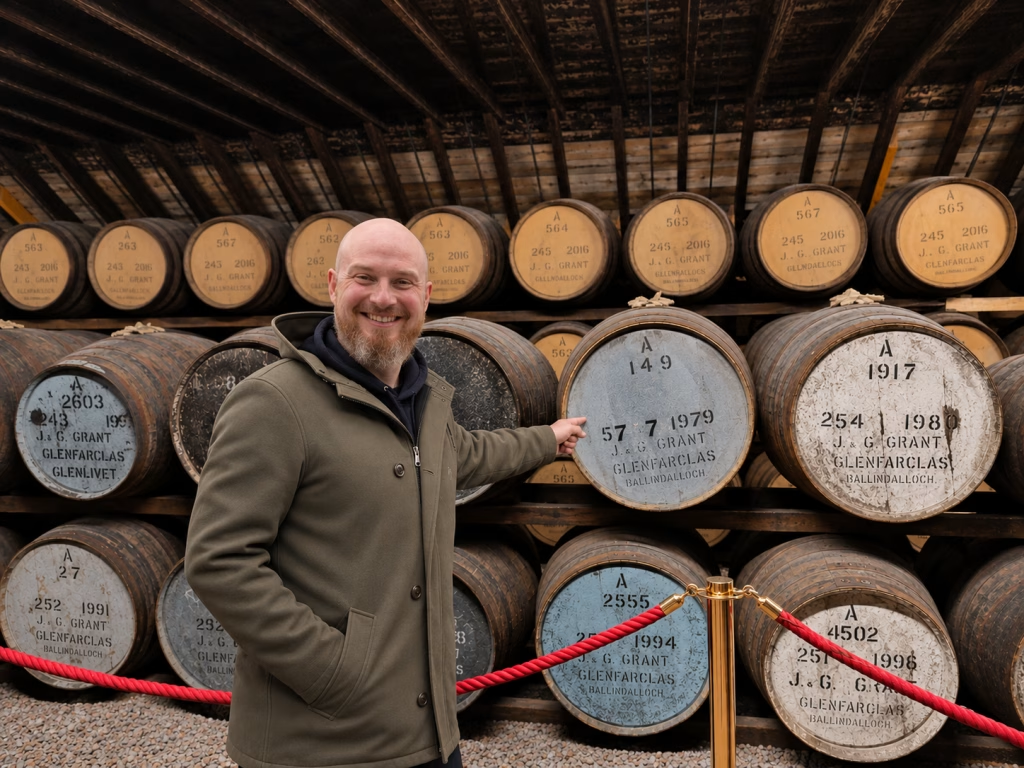
One of the finest illustrations I’ve encountered is the Glenfarclas 1979 The Family Casks, bottled in 2018. After approximately 39 years in a fourth-fill hogshead, it still displayed a remarkable abundance of tropical fruits: mango, guava, pineapple and lychee, accompanied by apricots, honey, delicate waxiness, barley and fresh grist. The oak was present, but it hadn’t buried the spirit beneath decades of wood extraction. Quite the opposite: the relatively restrained cask influence allowed its elegance and complexity to shine through. I rated it 9/10.
Of course, we can’t establish precisely how much of that tropical character developed during maturation and how much originated in the distillate. But the whisky demonstrates that very long maturation doesn’t have to mean overwhelming oak. Sometimes the most successful contribution a cask can make is to know when to stay relatively quiet.
The aim isn’t necessarily to extract the maximum possible amount from the oak.
It’s to allow the whisky to develop without losing what makes it interesting.
Survivorship bias: the old whiskies we actually taste.
There’s another complication when we judge the quality of old whisky.
The bottles that reach the market at forty or fifty years old aren’t necessarily representative of every cask filled forty or fifty years earlier.
Distillers and independent bottlers regularly assess casks and make decisions about when to use or bottle them. Some are selected for earlier releases, others are retained, and others may be blended or otherwise allocated according to their characteristics.
A cask showing exceptional potential for long maturation may be more likely to be kept than one that is already becoming unpleasantly woody.
This creates a potential selection effect, often called survivorship bias.
When we taste an excellent fifty-year-old whisky, we aren’t observing what automatically happens to whisky after fifty years. We’re often tasting a cask that was judged suitable for such extended maturation.
This is a reasonable explanation for why surviving very old bottlings may be unrepresentative, rather than a claim that every producer follows the same selection strategy. Producers also make decisions for commercial, financial and inventory reasons.
And even careful selection doesn’t guarantee excellence.
The remarkable old whiskies are remarkable partly because successful maturation over such long periods is difficult.
Can young whisky be just as good?
Absolutely.
A young whisky can be excellent if the new make is already attractive and the maturation complements it.

The Ardnahoe 5-year-old Inaugural Release is a good example. Matured in a combination of ex-bourbon and ex-Oloroso casks and bottled at 50% ABV, it delivered expressive peat smoke, grilled citrus, maritime notes, dark chocolate and a subtle, well-integrated sherry influence. It was energetic and intense, with a slightly oily texture and a good balance between smoke, fruit and spice. I rated it 7/10, describing it as an excellent blueprint for an inaugural release.
Was it as complex as some exceptional thirty-year-old whisky? No, and it didn’t need to be. At just five years old, it already had a coherent and enjoyable identity. More maturation might develop additional characteristics, but it could also change some of the vibrant qualities that made the whisky attractive in the first place.
Youth isn’t necessarily a defect waiting to be corrected.
In fact, some distillery characters are particularly appealing when they’re relatively young. Fresh fruit, vibrant cereal notes, coastal aromas and energetic peatiness can all be part of the attraction.
Extended maturation may develop those characteristics, but it may also soften, transform or obscure them.
That doesn’t make the older whisky worse. It makes it different.
The question is what the producer is trying to achieve, and what the drinker enjoys.
A young whisky doesn’t have to imitate an old whisky to be good.
Why colour isn’t a reliable shortcut.
Dark whisky is frequently associated with maturity.
But colour is influenced by the cask’s wood, previous contents, heat treatment and activity, as well as time.
A young whisky from a highly active cask may be darker than a much older whisky from a relatively inactive refill cask.
And for Scotch whisky, permitted plain caramel colouring introduces another possible influence.
Consequently, colour alone tells us very little about age or maturity.
A dark whisky isn’t necessarily old. A pale whisky isn’t necessarily immature.
And neither tells us whether the whisky will taste good.
Can maturation be accelerated?
If the beneficial effects of maturation involve chemical reactions and extraction, it’s reasonable to ask whether we can make them happen faster.
Producers have experimented with smaller casks, increased temperatures, pressure changes, agitation, alternative wood treatments and other techniques intended to accelerate particular aspects of maturation.
Some can indeed increase extraction or change chemical reaction rates.
But there’s a difference between accelerating a measurable process and reproducing the complete sensory development of long maturation.
A technique that increases vanillin extraction doesn’t necessarily reproduce the changes in esters, acids, aldehydes and other compounds that occur over decades.
Likewise, greater wood contact may create a stronger oak flavour without producing the balance associated with a well-matured whisky.
This doesn’t mean accelerated techniques are inherently inferior. They can produce interesting and enjoyable spirits, and innovation has a legitimate place in whisky production.
It simply means that faster extraction and faster maturation aren’t necessarily the same thing.
We should judge the resulting whisky on its merits rather than assuming that either traditional duration or technological intervention guarantees quality.
Does whisky continue ageing in the bottle?
This question often arises when discussing old bottlings.
Suppose you buy a twelve-year-old whisky bottled in 1980 and open it in 2026.
Is it now a fifty-eight-year-old whisky?
No.
Whisky age refers to maturation before bottling. Once the spirit is removed from the cask and sealed in glass, the normal processes of cask maturation cease.
There’s no continuing extraction from oak, and the bottle doesn’t provide the same environment for evaporation and interaction with wood.
A twelve-year-old whisky bottled in 1980 remains a twelve-year-old whisky.
But that doesn’t necessarily mean its composition is perfectly unchanged.
Whisky matures in oak. Bottling changes the conditions in which it can evolve.
In the cask
Wood, spirit and the warehouse environment interact.
In the bottle
The spirit is separated from the cask and stored in a sealed container.
A whisky matured for 12 years and then stored in glass for another 20 is still a 12-year-old whisky, not a 32-year-old.
Simplified illustration. Bottle storage can affect whisky over time, but those changes are not equivalent to maturation in an oak cask.
Bottle ageing isn’t cask maturation.
Chemical changes can still occur in bottled spirits.
The extent depends on factors such as oxygen in the headspace, the effectiveness of the closure, light exposure, temperature, storage duration and the composition of the whisky itself.
Poor seals may allow alcohol or volatile aroma compounds to escape. Exposure to light or heat may contribute to undesirable changes.
Even in well-stored bottles, very slow chemical processes may continue.
But these changes shouldn’t be confused with maturation in oak, and they don’t automatically improve the whisky.
Old bottlings can taste different from modern releases for numerous reasons: historical changes in production, barley, yeast, fermentation, distillation, cask management, vatting and bottling practices.
Differences caused by decades of bottle storage may also contribute, but separating those effects requires careful comparisons.
An old bottling isn’t necessarily better because it has spent forty years in glass.
It may be different because the whisky was made differently in the first place.
And sometimes, of course, it may simply have been a better whisky.
Can science tell us when a whisky is ready?
Chemical analysis can reveal an extraordinary amount about maturation.
Researchers can measure wood-derived compounds, track changes in volatile substances, identify patterns associated with age and investigate how different cask conditions affect the spirit.
These techniques are useful for understanding maturation, monitoring consistency and detecting certain forms of fraud.
But identifying chemical maturity isn’t the same as measuring quality.
A whisky’s sensory character depends on complex interactions between numerous compounds, many of which have different detection thresholds and contribute differently depending on their concentrations.
And even if we could describe every molecule in a glass, we’d still need to decide whether the resulting combination was enjoyable.
That’s a sensory and ultimately partly subjective judgement.
Distillers therefore rely on both analytical information and sensory assessment when evaluating casks.
A laboratory can tell us how much vanillin is present. It can’t definitively tell us whether the whisky has too much vanilla for our taste.
Nor can it determine with certainty whether a cask will improve with another five years.
It may help us make an informed prediction, but maturation doesn’t follow a universal recipe.
And sometimes the most important skill in whisky production is recognising when to stop waiting.
Too long, didn’t read.
(Because spending forty years reading an article about maturation would be taking the subject a little too seriously.)
A whisky’s age tells us how long its youngest component spent maturing in cask. It doesn’t tell us whether the whisky is mature, balanced or particularly enjoyable. A 30-year-old whisky isn’t automatically three times better than a 10-year-old. Unfortunately, pricing departments don’t always seem aware of this.
Maturation involves three broad processes: extraction of compounds from the wood, removal or transformation of substances already present in the spirit, and chemical reactions between them. These processes don’t all happen at the same speed, and none comes with a convenient countdown timer telling the distiller when perfection has been achieved.
The cask matters at least as much as the calendar. A young whisky in highly active oak may acquire more wood-derived flavour than a much older whisky in a relatively inactive refill cask. More vanilla, more tannins and more colour don’t necessarily mean more maturity. Sometimes they just mean more tree.
Temperature, humidity, cask size, previous fills and warehouse conditions all influence maturation. Warmer climates can accelerate certain processes, but there’s no scientifically defensible formula saying that three years in Taiwan equal twelve in Scotland. Whisky maturation isn’t a loyalty programme where you can exchange tropical years for Scottish ones.
Maturation doesn’t improve whisky indefinitely. A cask can develop beautifully for decades, or become excessively woody, bitter and drying. There’s no universal ideal age, and leaving a whisky for another ten years isn’t always an act of patience. Sometimes it’s an expensive mistake.
Very old whiskies can be extraordinary, but the exceptional examples we taste are often the result of careful cask selection. Not every whisky would become a masterpiece after fifty years. Some would simply become fifty-year-old disappointments, albeit with considerably more expensive packaging.
Young whiskies can be excellent too. A good distillate in a suitable cask may already be balanced, expressive and thoroughly enjoyable after just a few years. Youth isn’t necessarily a problem requiring another decade of oak-based therapy.
Finally, whisky doesn’t continue maturing in the bottle. A twelve-year-old whisky bottled in 1980 is still twelve years old today. It may have changed during storage, but it hasn’t magically become a fifty-eight-year-old. If only that worked for the rest of us.
The bottom line: age measures time, maturity describes development, and quality describes how successful that development has been. They’re related, but they’re not interchangeable. The best age for a whisky is the age at which it tastes best, not necessarily the largest number someone can print on its label.
Conclusion: time is an ingredient, not a guarantee.
So, does whisky really get better with age?
Often, yes. But not necessarily, and certainly not indefinitely.
Maturation can transform a raw, pungent new make into something wonderfully complex and balanced. It can soften aggressive characteristics, introduce new aromas and create combinations that simply weren’t present when the spirit entered the cask.
Some of those changes take time. And when the spirit, oak and maturation conditions work together, the results can be exceptional.
But every cask follows its own trajectory.
A whisky that tastes excellent at fifteen years might be even better at twenty-five. Another might already have reached its ideal balance. A third might have become too woody long before either age.
And while we can describe the chemical changes taking place, we can’t reduce their sensory success to a universal formula.
Personally, some of the most memorable whiskies I’ve tasted have been extremely old. The finest examples combine remarkable aromatic development with enough remaining distillery character to remind me of where they came from.
But I’ve also tasted wonderful young whiskies that needed nothing more than a good cask and a sensible decision about when to bottle them.
That’s perhaps the most important lesson: the purpose of maturation isn’t to make whisky as old as possible. It’s to make it as good as possible.
Sometimes that takes eight years. Sometimes twenty. Sometimes fifty.
And sometimes the best thing a distiller can do is open the cask before another birthday passes.
References and further reading
The following sources provide further information on whisky maturation, the chemical processes involved, the influence of oak casks, and the regulations governing Scotch whisky age statements. The scientific papers are freely accessible in full.
Scientific research
- Kelly, T. J., O’Connor, C., & Kilcawley, K. N. (2023). ‘Sources of Volatile Aromatic Congeners in Whiskey.’ Beverages, 9(3), 64.
An open-access review of the origins of whiskey aroma compounds, including those formed during fermentation, distillation and maturation.
Read the full paper - Gollihue, J., Pook, V. G., & DeBolt, S. (2021). ‘Sources of Variation in Bourbon Whiskey Barrels: A Review.’ Journal of the Institute of Brewing, 127(3), 210–223.
An examination of the factors responsible for differences between oak barrels, including wood composition, barrel construction and maturation conditions. Although focused on bourbon, much of the underlying wood chemistry is relevant to Scotch whisky maturation.
Read the full paper
Regulations and industry resources
- UK Government (2009). The Scotch Whisky Regulations 2009 (SI 2009/2890).
The legal framework governing Scotch whisky production, maturation, labelling and age statements, including the minimum three-year maturation requirement and the rule that an age statement must refer to the youngest whisky in the product.
Read the regulations - Scotch Whisky Association. Frequently Asked Questions.
Industry explanations of Scotch whisky production, maturation, age statements and related regulatory requirements.
Read the FAQs
Tasting examples from More Drams Less Drama
- Hakushu and Yamazaki 25-year-old (2024). An example of how extended maturation can produce remarkable aromas while oak influence may become excessive on the palate.
Read the review - Glenfarclas Family Casks 1979, 1967 and 1957 (2025). Three exceptionally old whiskies, including a 1979 vintage matured in a fourth-fill hogshead, illustrating how restrained wood influence can preserve distillate character over several decades.
Read the review - Ardnahoe 5-year-old Inaugural Release (2024). An example of a relatively young whisky already offering a convincing balance between distillate character and cask influence.
Read the review