
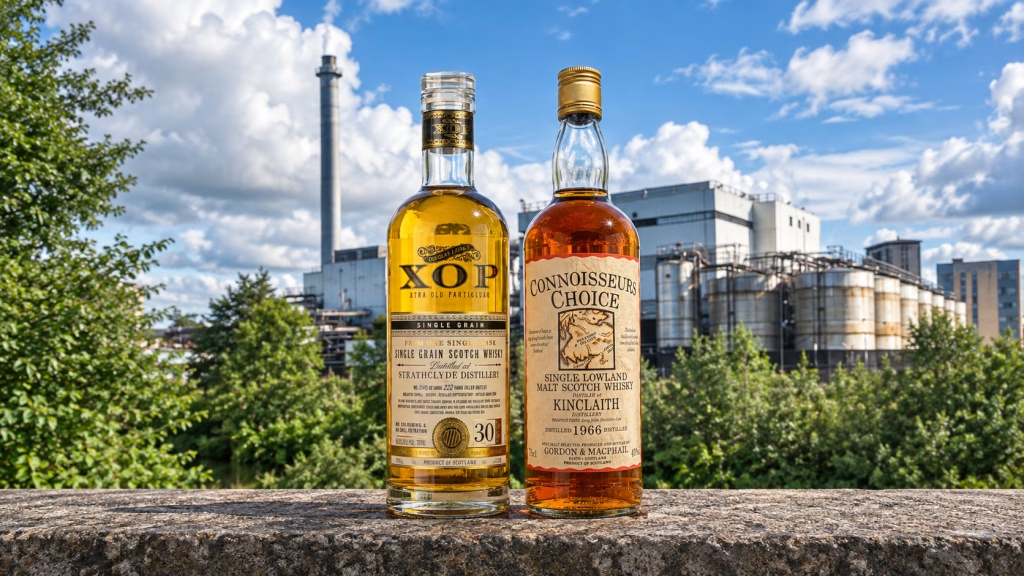
For today’s review, we’re heading to Glasgow and exploring two whiskies from distilleries that once shared the same site, but produced very different spirits. First, a Kinclaith 1966 bottled by Gordon & MacPhail, from a long-closed Lowland malt distillery that operated for just 18 years, between 1957 and 1975. Alongside it, a Strathclyde 1987 bottled by Douglas Laing under its XOP range, from the grain distillery that still operates on the same site today.
Two distilleries, one location, and two very different approaches to whisky production: traditional pot-distilled single malt versus continuously distilled single grain. An opportunity to explore two older expressions with a shared history, but very different origins and production methods.
Strathclyde Distillery
Strathclyde Distillery is located in the Gorbals district of Glasgow, on the southern bank of the River Clyde, and is classified as a Lowland grain whisky distillery. Established in 1927 by Seager Evans & Co. on the site of a former cotton mill, it was originally developed to produce neutral grain spirit for the company’s gin brands. The company expanded into Scotch whisky in 1936 with the acquisition of the Long John blended whisky brand.
In 1956, Seager Evans was acquired by the American company Schenley Industries, which subsequently invested in the site. In 1957, a small malt whisky distillery named Kinclaith was established within the Strathclyde complex, allowing the site to produce both malt and grain whisky. This arrangement continued until 1975, when Whitbread acquired the business and dismantled Kinclaith to make room for additional grain whisky production.
Strathclyde uses continuous distillation rather than the traditional copper pot stills associated with malt whisky production. Its grain whisky is produced primarily from wheat, with a smaller proportion of malted barley to provide the enzymes required for starch conversion. The distillery uses water from Loch Katrine and operates a two-column Coffey still system, consisting of an analyser and a rectifier. This arrangement allows continuous separation and concentration of alcohol, producing a relatively high-strength spirit compared with conventional pot still distillation.
The distillery underwent significant modernisation and expansion, including developments in 2002. Its annual production capacity is approximately 39 million litres of pure alcohol, making it one of Scotland’s larger grain whisky distilleries. Following the acquisition of Allied Domecq by Pernod Ricard in 2005, Strathclyde became part of Chivas Brothers, which continues to operate the site.
Most of Strathclyde’s production is intended for blended Scotch whiskies, including Ballantine’s and Chivas Regal. Its grain spirit provides a component of these blends alongside malt whiskies from other distilleries. Despite its substantial production capacity, Strathclyde has no established range of official single grain bottlings.
Independent bottlers, including Berry Bros. & Rudd, Douglas Laing and the Scotch Malt Whisky Society, have released single grain expressions from Strathclyde, often after extended maturation. These bottlings provide an opportunity to examine the influence of long-term cask maturation on grain whisky, which can develop pronounced vanilla, caramel, coconut, spice and oak characteristics depending on the cask and maturation conditions.
Kinclaith Distillery
Kinclaith was a Lowland single malt Scotch whisky distillery located within the Strathclyde grain distillery complex in the Gorbals district of Glasgow. Established in 1957 by Seager Evans & Co., following the company’s acquisition by Schenley Industries in 1956, it was created to supply malt whisky for the Long John blended Scotch whisky brand. Unlike conventional malt distilleries, Kinclaith operated within an existing industrial grain distillery rather than as a separate production site.
The distillery was equipped with a single pair of copper pot stills, comprising one wash still and one spirit still, and used traditional double distillation. Its production water came from Loch Katrine, which also supplied water to Glasgow. Historical technical information is relatively limited, although some records indicate that Kinclaith operated six stainless-steel washbacks. Its annual production has been estimated at approximately 200,000 litres of spirit, making it a relatively small operation even by the standards of the period.
Kinclaith produced malt whisky primarily for blending, and contemporary descriptions suggest a relatively full-bodied spirit with some lightly smoky characteristics. However, surviving tasting records are limited, and individual independent bottlings have displayed considerable variation in character.
Production ended in 1975, following the acquisition of Seager Evans by Whitbread. The malt distillery’s equipment was dismantled to allow the expansion of grain whisky production at Strathclyde. Kinclaith therefore operated for only 18 years, and no further spirit has been produced under its name since its closure.
No official Kinclaith single malt bottlings were released during the distillery’s operating years. The limited quantities available today originate from surviving casks subsequently bottled by independent companies, including Cadenhead’s, Gordon & MacPhail, Signatory Vintage and Duncan Taylor. With no possibility of further production and increasingly limited remaining stocks, Kinclaith has become one of the less frequently encountered closed Lowland malt distilleries.
Kinclaith 1966 Old Map Label Gordon & Macphail Review
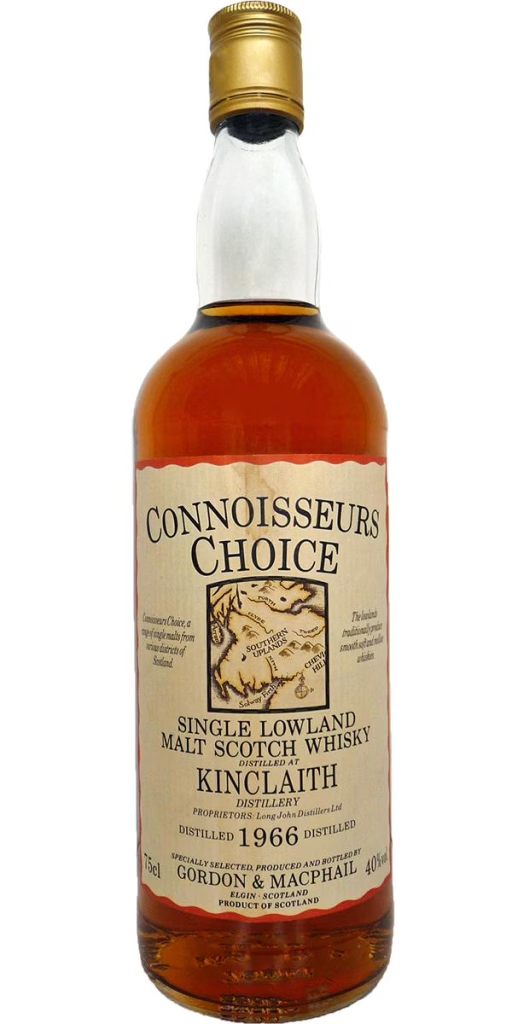
This Kinclaith was distilled in 1966 and released by Gordon & MacPhail in its Connoisseurs Choice range, identifiable by the cream-coloured label featuring an old map of Scotland. This label design was used approximately between 1989 and 1997, although the exact bottling year of this expression has not been established. The Old Map release was bottled at 40% ABV in 5 cl and 75 cl format. No age statement is recorded for this version, and although the label period provides a broad indication of its age, assigning a precise maturation period would be speculative. The original cask type, whether the whisky was chill-filtered or artificially coloured, and the total number of bottles produced have not been reliably documented.
Colour:
Amontillado sherry.
Nose:
Neat: An initially dusty and slightly austere nose, with dried hay, old cereal and a soft, creamy sweetness. Honey, yellow apples and tinned apricots gradually emerge, followed by peach and mandarin orange. There is a slightly vinous character in the background, accompanied by delicate vegetal notes, a little mint and something reminiscent of vegetable oil. A faint chalky or metallic quality adds an unusual dimension, while the aromas gradually become more integrated with time in the glass.
Palate:
Neat: A sweet and moderately spicy arrival, with caramelised apples, ripe peaches, strawberries and redcurrants. Overripe melon contributes a softer, slightly tropical fruitiness, while honey, caramel and a light sherry-like sweetness provide a rounded background. The texture is somewhat oily despite the 40% bottling strength. Cinnamon, pepper and liquorice introduce a gentle spicy contrast, accompanied by salted butter and almonds, with a suggestion of amaretto. A slightly metallic note continues from the nose, together with a faintly dusty, vegetal character.
Finish:
Rather short, with lingering malt sweetness, caramel and a slightly vinous fruitiness. A touch of salt provides contrast, while the fruit gradually fades into mild oak and a faint woody astringency. The dusty, metallic character noted earlier becomes more perceptible.
Comments:
On the nose, this Kinclaith overall impression is of a mature, rather subdued whisky, combining orchard fruits and honeyed sweetness with dusty, vegetal and faintly mineral characteristics. On the palate, the flavours appear reasonably well integrated, although the overall intensity remains moderate, with the fruit and sweetness occasionally competing with a slightly astringent woody edge. The finish is particularly persistent, with the sweeter flavours disappearing fairly quickly and leaving a mildly drying impression. This Kinclaith, probably filled around 30 years ago, is probably suffering a bit from Old Bottle Effect, but stays nonetheless a nice view on a long gone and short-lived malt distillery.
Rating: 7/10
Strathclyde 1987 XOP Douglas Laing (2018) Review
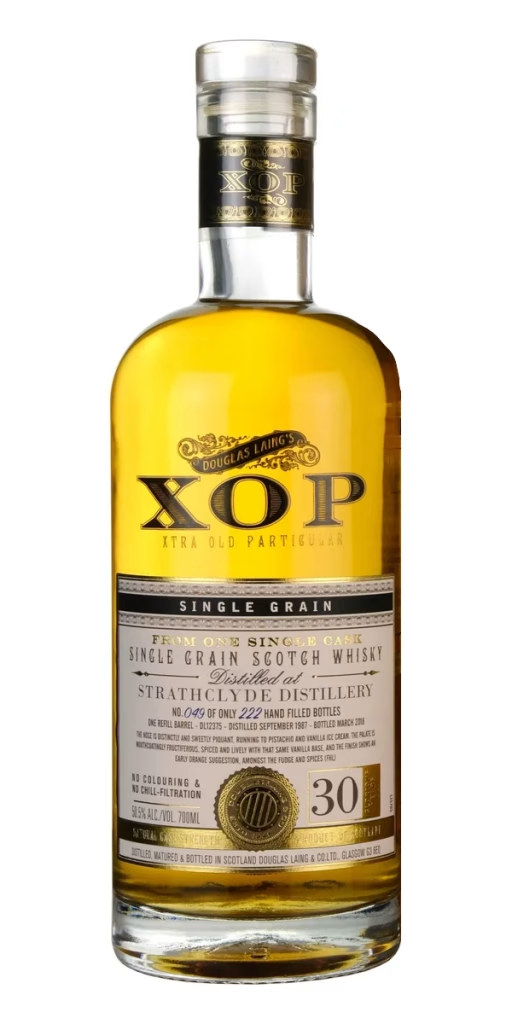
This Strathclyde was distilled in September 1987 and bottled in March 2018 by Douglas Laing as part of its Xtra Old Particular (XOP) range. Established in Glasgow in 1948, Douglas Laing specialises in independent bottlings of Scotch whisky, including single malts and single grains. The XOP series concentrates on older, individually selected casks, generally bottled at natural strength without chill filtration or added colouring.
The whisky spent 30 years in refill barrel number DL12375, yielding 222 bottles at 50.5% ABV. It was bottled at cask strength, without chill filtration or artificial colouring. The refill barrel is identified as having previously held bourbon by Whisky-Online, although Whiskybase itself records only the more general designation of refill barrel. This release is unfortunately sold out.
Colour:
Old gold.
Nose:
Neat: The nose features a sweet and creamy opening, with vanilla ice cream and pistachios providing the principal aromatic characteristics. The sweetness is accompanied by a slightly piquant quality, suggesting a contrast between confectionery-like aromas and a more lively, spicy edge. The pistachio note introduces a distinctly nutty dimension, while the vanilla gives the impression of a softer, rounded background. But, all in all, the nose stays somewhat simple.
With water: Reduction brings out a little bit of grainy harshness at first, disturbing the balanced the whisky reached after 30 years of maturation. Once it settles down, the vanilla moves to full on thick custard and vanilla pods.
Palate:
Neat: The palate has a sweet, fruity arrival, with a pronounced vanilla character continuing from the nose. The texture is mouth-coating. Fruitiness becomes more apparent than on the nose, accompanied by a lively, warming spiciness. The palate shows creamy vanilla and nutty characteristics, with apricot and peach flavoured yogurts.
With water: The mouthfeel becomes creamier, and oak tannins appear quite noticeably. Behind them, the vanilla stays present, but joined by an unexpected bitterness.
Finish:
The finish is medium in length and shows fudge-like sweetness, vanilla and lingering spices, with light fresh citrus and confectionery sweetness.
Comments:
This Strathclyde 1987 is a nice old grain whisky, but make sure to drink it neat, as the addition of a few drops of water tends to change it from a syrupy and creamy vanilla grain to something a bit disjointed, harsh and oaky.