We introduce two new distilleries at the same time, as we taste a Dornoch 5-year-old from the Mystery Malt Batch 3 and a Clydeside 2023 Limited Edition. And, as we add these distilleries to the blog, it’s also our first time trying whisky from these distilleries. As its ABV is the lowest of the two, we’ll start with the Dornoch, then the Clydeside, but first, let’s talk about these distilleries, in that same order.
Dornoch Distillery
Dornoch distillery is one of those rare modern projects that feels, from the outset, like a deliberate love letter to an older style of Scotch. Its story really begins behind the bar of the Dornoch Castle Hotel, a 15th‑century fortress turned family‑run hotel overlooking the square in the Highland town of Dornoch. There, brothers Simon and Philip Thompson spent their formative years pouring drams, building up an astonishing whisky list and, crucially, falling head over heels for pre‑1960s Scotch – the waxy, textural, long‑fermented malts that had quietly slipped out of fashion as the industry modernised.
The hotel bar became a destination in its own right, drawing enthusiasts north for a chance to drink old Clynelish, Brora and anonymous blends from a bygone era. I had the chance to go there once back in 2019. The selection was astonishing, and the prices reasonable. Then, the brothers gradually moved from curating those bottles to bottling their own as independent bottlers. By the early 2010s the idea of a distillery on the castle grounds had gone from bar‑room fantasy to concrete ambition: if nobody was making whisky quite like those old bottles any more, they would have to try to do it themselves.
Planning permission arrived in 2015 to convert a disused 19th‑century Victorian fire station in the castle courtyard – then little more than a junk store – into what would become one of Scotland’s smallest legal distilleries. To fund the project, the Thompsons did the very opposite of courting corporate investment: they sold their flat, leaned on the success of their young bottling business and launched a crowdfunding campaign that drew in more than two hundred enthusiasts from around the world. Those early backers effectively pre‑bought spirit and future bottlings, and many of them still follow every cask the brothers lay down.
Dornoch distillation began in earnest in late 2016, with ’Cask 0′ of single malt spirit filled in February 2017—a test run that already embodied the house philosophy. Rather than chasing efficiency, the distillery embraced what the brothers had admired in their favourite old‑style whiskies: heritage barleys like Plumage Archer, Maris Otter and Orkney bere from Scottish farms; floor malting; week‑long fermentations enlivened not just by yeast but also by lactic bacteria; and small, manually operated stills more attuned to nuance than volume. Washbacks are cleaned by hand but never sterilised, maintaining what the Thompsons call a ‘living memory’ of previous fermentations, a practice drawn straight from mid‑20th‑century Scotch rather than modern industrial norms.
While the whisky matured, the distillery kept the lights on and the stills warm by turning out gin. Thompson Bros Organic Highland Gin, built on the same obsession with provenance and flavour, arrived in 2017 and quickly found favour for its sharp, characterful botanical profile. On the whisky side, the brothers continued to bottle casks from other distilleries under the Thompson Bros label, effectively using independent bottlings as a parallel laboratory and revenue stream, while their own casks matured in the background.
The first official Dornoch single malt, ’Dornoch 2017 3-Year-Old Single Cask #001 – Thompson Bros Inaugural Release’, finally emerged in 2022, closing the loop that had begun back in the castle bar. By then, the distillery’s reputation far outstripped its tiny 20,000‑litre annual capacity; single cask releases disappeared almost on announcement, pulled into the orbit of collectors who had already fallen for the Thompson Bros’ independent bottlings. In the same year, the brothers announced plans for a new, much larger and eco‑friendly distillery in Dornoch – a roughly £7 million project designed to scale their old‑style production philosophy without sacrificing its character.
Today, Dornoch distillery sits at the centre of a small but remarkably dense ecosystem: the castle hotel with its bar still pouring venerable old bottles, the original courtyard distillery, the independent bottling arm, a retail space and the planned new site on the edge of town. Yet for all that growth, the core of the story remains charmingly simple. Two brothers stood behind a bar, fell in love with the texture and quiet complexity of old whisky, and decided to see whether that style could be coaxed back into the glass using 21st‑century tools but unapologetically 20th‑century instincts.
Clydeside Distillery
Few places evoke Scotland’s industrial past, quite like the quayside of Glasgow’s River Clyde, where massive shipyards once thrummed and the Queen’s Dock bustled with maritime commerce. In 1877, contractor John Morrison constructed a distinctive pumphouse right at the dock’s entrance, its hydraulic machinery regulating water levels to allow vessels safe passage in and out. That same red sandstone building, perched on the riverbank and overlooking the infilled docks now occupied by the SEC Centre, would sit largely forgotten for over a century – until the 21st century called it back to life as the Clydeside Distillery.
The revival traces directly back to Morrison’s great-grandson, Tim Morrison, whose family had deep roots in Scotland’s spirits trade, having owned Morrison Bowmore Distillers until selling it to Beam Suntory in 1994. Tim, through his Morrison Glasgow Distillers, saw the derelict pumphouse not as a relic but as a resonant symbol: a chance to restore whisky production to Glasgow’s heartland, where it had thrived in the 19th century before fading away. Construction began in 2016 under McLaughlin & Harvey, transforming the Victorian structure with a £10.5 million investment that preserved its heritage while installing gleaming modern equipment.
Clydeside opened its doors in November 2017, becoming Glasgow’s second active distillery in more than a century – following hot on the heels of the Glasgow Distillery Company’s revival efforts. The first casks filled that December, marking a deliberate return to Lowland single malt style: light, herbaceous, unpeated expressions drawing pure water from Loch Katrine in the Trossachs. Two Forsyth-built stills, each weighing around two tonnes, anchor the operation, fed by eight stainless washbacks with a capacity of up to 500,000 litres annually – modest by contemporary standards but perfectly scaled for a visitor-focused site.
Tim’s son, Andrew Morrison, serves as operations director, while former Auchentoshan manager Alistair McDonald oversees production, bringing Lowland expertise to the stills. From the start, Clydeside prioritised accessibility alongside authenticity, crafting tours that blend self-guided exhibits on Glasgow’s whisky heritage with live distillery walkthroughs and tastings in a sleek riverside room. The visitor centre, shop and café quickly drew crowds, positioning the distillery as much a cultural hub as a production site.
The pivotal milestone arrived in 2021 with the debut of Clydeside’s first single malt, Stobcross – a nod to the nearby historic street. It matured into a mix of American and European oak casks. It is said to embody the house’s character: elegant florals, subtle spices and that signature Lowland delicacy, bottled at 51.4% ABV. Subsequent releases have built on this foundation, including cask-strength editions and limited finishes, all while the core spirit matures in the pumphouse’s warehouses.
Dornoch 5-Year-Old Mystery Malt Batch 3 (2025) Review
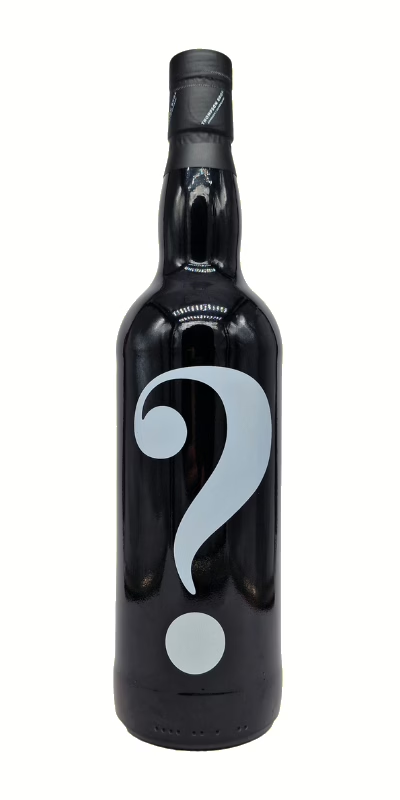
This Dornoch 5-year-old was one of the possible bottles in the Thompson Brothers’ Mystery Malt Batch 3. It matured for 5 years in several ex-bourbon octaves, before being bottled in 2025 at 48.5% ABV. Only 157 bottles were filled to be part of the Mystery Malt Batch 3, without chill filtration nor added colour. You’d have to be very lucky to one, find a bottle still for sale from that batch and two, that it is in fact that Dornoch (and you have to remove the first seal to know what bottle you bought), but other and larger batches have been released since.
Colour:
Burnished.
Nose:
Neat: This Dornoch reveals a bright, youthful vibrancy on the nose, where lively lemon oil and candlewax mingle with vanilla fudge and a backdrop of brown sugar alongside freshly sawn oak. Green apple slices, pear, and coconut shavings emerge alongside soft peach and tinned pineapple. In the meantime, ginger and green peppercorns lend a lightly spicy edge to the ex-bourbon sweetness. Finally, there is a touch of fruit peel compost that gives out a slightly off note.
Palate:
Neat: An initial creamy arrival brings caramel sweetness and an oily texture to the palate, swiftly unfolding into green apples, peaches, dried apricots, and poached pears. Vanilla cream and honeyed malt layer over peppery, gingery oak, accented by citrus peel and a youthful alcohol zing that underscores the small ex-bourbon octaves’ concentrated fruit and wood spice.
Finish:
The finish stretches to a medium length, sweet yet slightly drying, with lingering vanilla fudge, ginger spice, and toasted oak. Faint echoes of coconut and citrus zest persist, joined by a lightly astringent woody grip that beckons the next sip.
Comments:
Dornoch makes a compelling debut, revealing considerable promise through a robust aromatic profile, layered flavours, and satisfying texture despite its youth. While the small casks and tender age occasionally work against it, the distillery’s potential shines through clearly. Future expressions from more judiciously active casks will merit close attention.
Rating: 6.5/10
Clydeside 2023 Limited Edition (2023) Review
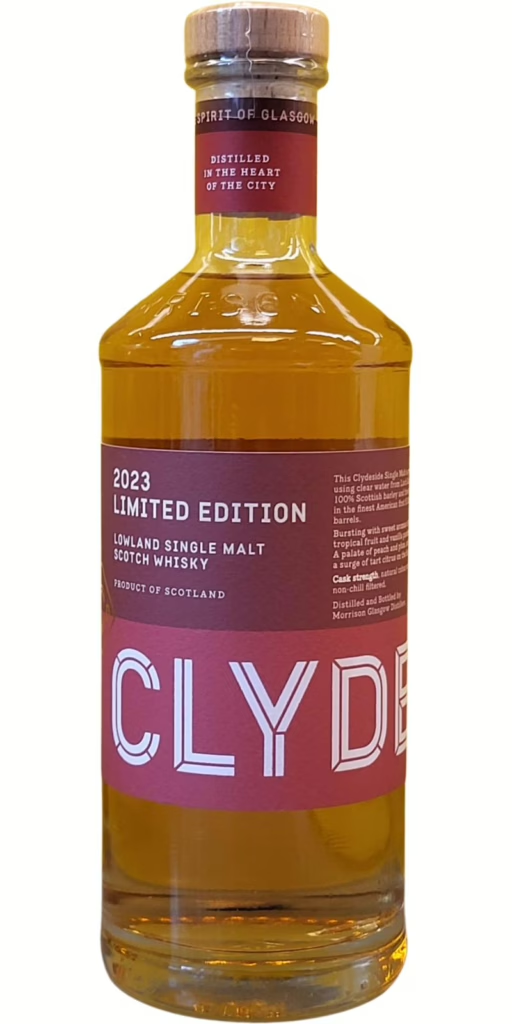
Next, we have a Clydeside 2023 Limited Edition. Made from Scottish barley, it was bottled between the 25th and the 29th of August 2023. This whisky matured in first-fill bourbon barrels, before being bottled at cask strength (60.6% ABV), without chill filtration nor added colour. This is still available, from €65 in Germany, and £69 in the UK (on Clydeside’s website).
Colour:
Pale gold.
Nose:
Neat: The nose starts with overripe mangoes and papayas, orange marmalade, and vanilla pastries. There is a light grassy aroma of damp and freshly mowed lawn, then hints of durian and dragon fruits. Coconut husks, hints of grapefruits and pears, apricot filled croissants and dried flowers.
With water: A few drops of water softens the cask strength’s heat even more, amplifying the fruity malt and orange marmalade on the nose while revealing creamier vanilla pastry notes beneath the tropical lushness.
Palate:
Neat: The palate delivers lush peach and plum, building to a surge of tart citrus, oak-driven spices and vanilla erupt, underscoring the high proof’s intensity. The alcohol feels integrated despite the high ABV, as it is noticeable but doesn‘’’t burn at all. The mouthfeel is oily and slightly drying. Afterwards, the youth shows itself more with loads of green apples and pears, and some oak bitterness expressing the active casks.
With water: Peach and plum gain juicy depth alongside hints of pineapple and sherry-like richness, transitioning into spiced vanilla and citrus.
Finish:
The finish is medium-long, citrusy with some oak spices and bitterness. Crushed almonds, coconut husk and shavings, with a touch of pine sap.
Comments:
Clydeside proves a gratifying find, delivering a very good nose and palate despite its youth, with alcohol seamlessly integrated. While the spirit’s age remains perceptible, the first-fill casks enrich it without the over-extracted, cooked character that STR or virgin oak can impose – even on whiskies from older distilleries. I guess I can consider Clydeside another distillery that warrants close attention.
Rating: 6.5/10
Dornoch sample provided by Dramtime.eu, complementary to an order.