On special days, I like to reach for something special, so I chose two Coleburn whiskies from Signatory Vintage for Christmas. After a lengthy cognac session from the Cognac-Expert 2025 Advent Calendar, I return to whisky. Coleburn has tempted me for ages, especially since my 2019 visit to Murray McDavid at Spirit of Speyside – where they lease the distillery’s warehouses for cask storage, though workers dismantled the site long ago. Sourcing Coleburn proved tough, yet I snagged two samples in days. As always, I’ll start with the distillery history before diving into these festive Signatory pours.
Coleburn Distillery
Coleburn Distillery, located in Speyside, traces its origins to the late Victorian whisky boom of the 1890s. Dundee blenders John Robertson & Son founded it around 1896 or 1897 at Coleburn Farm south of Elgin and Longmorn. Architect Charles Doig designed the site to include two copper pot stills that began operation circa 1899. Positioned beside a Great North of Scotland Railway branch line, it supplied malt primarily for blends from firms like Johnnie Walker and Usher’s. The distillery also served as an experimental workshop for new techniques in the early 1900s.
The distillery shuttered briefly around 1913, then sold in 1915 to the Clynelish Distillery Company – backed by John Risk, John Walker & Sons, and Distillers Company Ltd (DCL) – before fully entering DCL/Scottish Malt Distillers ownership by the mid-1920s. Post-war upgrades in the 1950s–60s modernised the mash house, swapped worm tubs for shell-and-tube condensers, and boosted efficiency to support DCL’s blended Scotch lines. Amid the 1980s ‘whisky loch’, operators mothballed it in March 1985, surrendered the license in 1992, and removed the stills, marking it as a lost distillery under Diageo (DCL’s successor).
Diageo kept the brand but sold core buildings in 2004 to the Winchester Brothers, who eyed a whisky resort development. Since 2014, independent bottler Murray McDavid (under Aceo ownership) has leased the dunnage warehouses for maturation, making Coleburn its operational base. Single malts remained rare officially – a 2000 Rare Malts 21-year-old debuted the profile – with independents like Gordon & MacPhail and Signatory Vintage dominating releases.
Recent Winchester Brothers initiatives, announced in the mid-2020s, aim to revive ‘The Distillery at Coleburn’ as a production facility and visitor resort, potentially restarting distillation after four decades idle. However, the revival efforts faced hurdles. As in 2014, Aceo Ltd. signed a long-term warehousing lease and since can operate on-site as Coleburn Distillery Ltd. Legal disputes over brand names and trademarks erupted between Aceo and D&M Winchester, Aceo owning the rights to the Coleburn Distilley name. This prompted the latter to brand their project The Distillery at Coleburn for distinction. Aceo even released recently since 2022 some blended malts named as Coleburn, even though they have probably not even a drop of the original Coleburn whisky.
Coleburn 1983 Signatory Vintage (1997) Review
Out first Coleburn was distilled on the 30th of April 1983. It was bottled at 14 years of age by Signatory Vintage in August 1994. This is the vatting of two casks (numbered 795 and 796), giving an outturn of 540 bottles filled at just 43% ABV, and released as part of Signatory’s Vintage Collection. This expression is sold out.
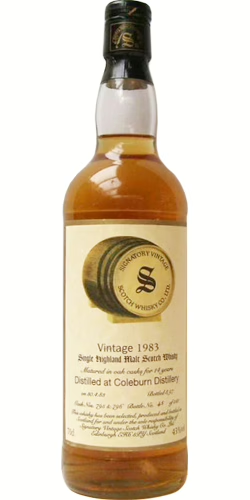
Colour:
Jonquille
Nose:
Neat: Elusive tropical fruits flash briefly before vanishing, giving way to yellow-fleshed pears, peaches, apricots, and plums, alongside dusty bookshelves and light yogurt lactic notes. Simple and pleasant.
Palate:
Neat: Fruity, floral, and peppery with initial soapiness that manages but intensifies over time. Alongside these are apple, cheap milk chocolate, instant coffee, bitter knackered wood and damp cardboard. There is also fructose sweetness from apple juice and corn syrup, plus lavender or violet sweets from the South of France.
Finish:
Cheap chocolate, wood, recurring floral sweets, and damp cardboard trail into medium length.
Comments:
The nose delivers a pleasant fruity profile – engaging without excessive layers. The palate disappoints somewhat, yet flaws aside, this dram remains likeable enough to warrant a retry soon.
Rating: 6/10
Coleburn 1981 Signatory Vintage (2001) Review
This Coleburn was distilled on the 22nd of October 1981. It was then bottled by Signatory Vintage in their The Un-Chillfiltered Collection on the 17th of May 2001. It spent 19 years in Sherry Butt number #1341 before being bottled at 46% ABV. This allowed an outturn of 785 bottled filled without chill filtration nor added colour. A couple of shops seem to have a few bottles left in stock, but you’ll have to pay around €500 for a bottle.
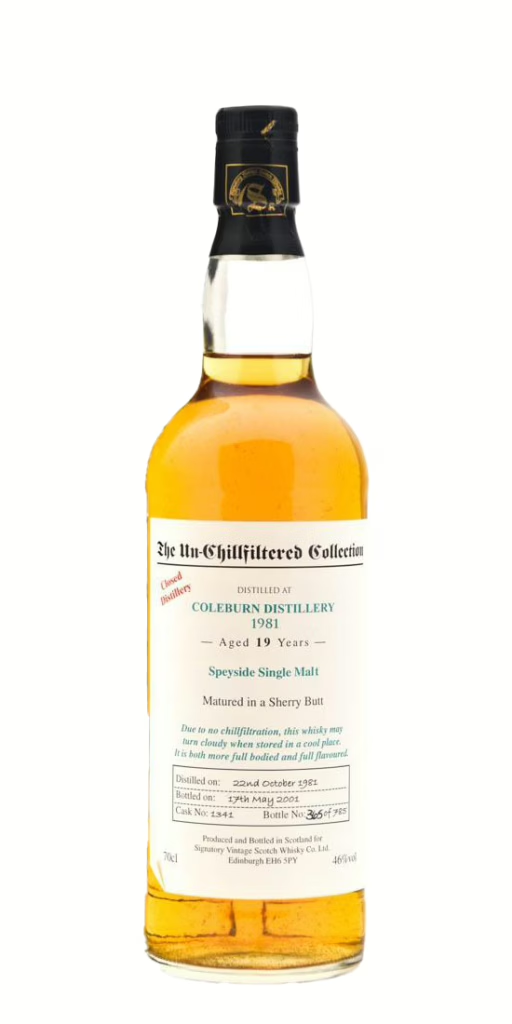
Colour:
Chestnut
Nose:
Neat: Sweet caramel, brown sugar, and whipped cream open the nose. However, light sulfur aromas and tyre dust, probably from a slightly dirty sherry cask, quickly join these first aromas. Then, the nose evolves into mirabelle plums, bergamot, lavender, and citrus peels like orange and lemon. Afterwards, more funk appears, with grappa, yogurt and bananas. Barley, draff, nuts, leather and cut grass.
Palate:
Neat: The palate starts with pear and peach compote, dried fruits, raspberries, and juicy pears. There is a salty minerality and a light bitterness, with oak spice, pepper, cloves and nutmeg. A light touch of tropical fruits and orange liqueur bring a nice tartness. Leather, tobacco, spicy chocolate, and something savoury as well.
Finish:
The medium to long finish brings orange marmalade, cedar wood, leather, ginger, and cocoa, slightly drying out with oak, funk, and subtle bitterness.
Comments:
While the first Coleburn showed flaws, this 1981 Signatory Vintage excels. Initial nose concerns from light sulfur and estery funk yield to a palate that elevates those esters into tropical vibrancy and savoury depth. The larger 50 ml sample proves a wise choice, but it’s time to try to source more.