A single whisky this time, for once, at More Drams: a Pittyvaich 1979 bottled by Duncan Taylor in 2007. I wanted a final celebratory dram for my birthday – one that felt both personal and symbolic. Choosing a whisky from a closed distillery I’d never tasted before, and from my own birth year, seemed like the perfect way to mark the occasion.
Pittyvaich Distillery
Pittyvaich is one of those classic ‘blink and you missed it’ Speysiders: a distillery built in the boom years of the 1970s, gone by the early 1990s, and now surviving only in a shrinking stock of casks and a handful of official and independent bottlings. Its story is short, almost brutally so, but it says a lot about how Scotch was being made – and unmade – during that period.
The distillery was born in Dufftown, the self‑styled malt whisky capital of the world, where the Dullan Water and the Fiddich shape a landscape already crowded with familiar names like Dufftown, Mortlach, Glendullan and Balvenie. In 1974, Arthur Bell & Sons decided they needed more malt to feed the soaring demand for Bell’s, then on its way to becoming the best‑selling Scotch in the UK. Rather than expanding an existing site, they put up a thoroughly utilitarian new plant right next door to Dufftown distillery – Pittyvaich, conceived unapologetically as a workhorse for blends. Construction finished in the mid‑1970s, and production began in 1975, with a pair of stills later doubled to four as the boom rolled on.
Architecturally, Pittyvaich was pure 1970s: a functional shed in Dullan Glen housing its mash tun, washbacks and stills, with none of the romantic stonework that makes visiting older sites so photogenic. It drew its water from the Bailliemore and Convalleys springs and ran essentially in parallel with Dufftown, sharing the same general supply network and sitting among that maze of warehouses on the edge of town. Inside, the brief was simple – turn out a clean, reliable Speyside spirit for Bell’s. Most of it disappeared anonymously into blends, and for years very little single malt left the site in its own name.
Corporate reshuffling did as much to shape Pittyvaich’s fate as any local factor. Bell’s was snapped up by Guinness in 1985, and the following year Guinness acquired DCL, forming what would become United Distillers. In the rationalisation that followed, with global stocks looking comfortable and demand cooling, newer, less characterful sites built purely for volume were easy targets. Pittyvaich, which had only been running since 1975 and had little brand equity of its own, found itself surplus to requirements.
There was one brief moment in the spotlight before the end. In 1991, United Distillers slipped Pittyvaich into its now‑legendary Flora & Fauna range, bottling a 12‑year‑old that effectively served as the distillery’s only regular official single malt during its lifetime. Independent bottlers like Signatory and Cadenhead’s had already shown there was an interesting spirit to be found in the warehouses, but it was too little, too late. In 1993 the stills fell silent, less than two decades after first running, making Pittyvaich one of Scotland’s shortest‑lived malt distilleries of the modern era.
The physical erasure came next. For a while in the mid‑1990s, the site was pressed into service as back‑up capacity for Gordon’s gin, but the writing was on the wall. In 2002, Diageo – by then the corporate successor to United Distillers – demolished the distillery’s buildings, leaving only warehouses and a dark grains plant to process draff and pot ale from Dufftown, Glendullan and Mortlach. Today, if you walk the Dufftown site, Pittyvaich survives mostly as a patch of open ground and a name on old site plans.
What remains, instead, is liquid memory. All remaining stocks sit under Diageo’s control, occasionally surfacing as part of its Special Releases lineup, framed as ‘deeply rich and complex’ relics from an ultra‑short‑lived Speysider. A few casks continue to trickle out through independent bottlers and auction houses, where the appeal is as much about rarity and lost‑distillery romance as about flavour. For a distillery that began life as little more than a volume solution for Bell’s, that’s a quietly ironic afterlife: from anonymous blend filler to cult curiosity, its entire history compressed into less than twenty years of production and a scattering of bottles left to tell the tale.
Pittyvaich 1979 Cask #5633 Duncan Taylor (2007) Review
This Pittyvaich was distilled in April 1979, and underwent 28 years of maturation in a hogshead, numbered #5633, before being bottled in April 2007 by Duncan Taylor. The hogshead gave an outturn of 174 bottles filled at 52.7% ABV, without chill filtration nor added colour.
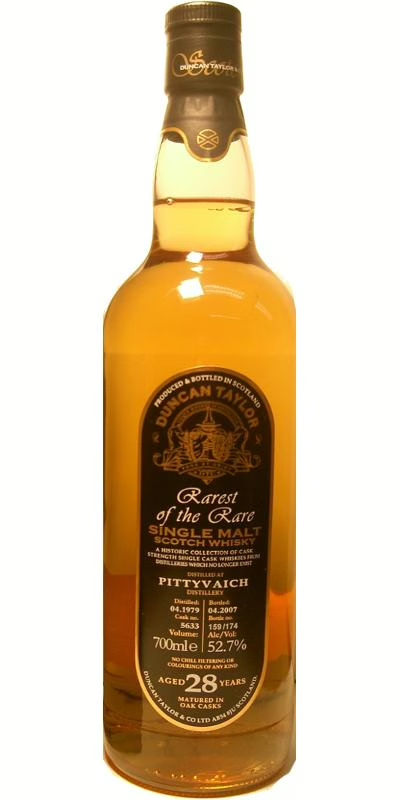
Colour:
Pale gold.
Nose:
Neat: The nose is light and elegant, opening on ripe pear and green apple with a subtle pear eau de vie richness and soft vanilla cream. There is a gentle herbal edge – hints of hay, fresh grass and faint herbs – alongside a light, slightly dusty old‑school note that speaks to its age without feeling tired. Later, a touch of hay and soft oak emerges, keeping the profile bright and Speyside‑fresh rather than heavy or overly woody.
With water: A splash of water softens the alcohol heat and amplifies the pear and apple notes on the nose, making the vanilla and herbal tones more approachable without losing the whisky’s poise.
Palate:
Neat: On the palate, the whisky remains light and refined, with juicy pears and crisp green apple leading the way, underscored by a delicate vanilla sweetness. The mouthfeel is velvety rather than oily, with a gentle acidity that keeps the fruit lively. The oak, however, is more present than on the nose and provides a touch of unbalance. The cask strength adds peppery warmth in the background, but it never overwhelms the clean, fruit‑forward character.
With water: The fruit becomes juicier and the vanilla creamier, with the peppery oak integrating more smoothly. Reduction also provides more tartness, with grapefruit and lime.
Finish:
The finish is long and fading, with the orchard fruit and vanilla gently receding into soft oak and a hint of herbs. There are no surprises here—everything that appears on the nose and palate lingers in a harmonious, relaxed close that feels both satisfying and understated.
Comments:
This Pittyvaich 1979 from Duncan Taylor is my first meet with this short-lived distillery, and will leave a positive impression. This whisky shows fruitiness and decent complexity for the age, but it feels like it might have been better to bottle it a couple of years earlier, as the oak left a slightly too-strong imprint on the palate. This stays, however, a very decent dram, really nice to sip and nose.
Rating: 6.5/10
Thanks Jan!