Single malt is supposed to be the opposite of blended whisky. Except that your favourite single malt may contain whisky from dozens – or hundreds – of different casks, vintages, ages and cask types, all combined to create the final bottle. Meanwhile, even single cask doesn’t necessarily mean quite what we instinctively assume. So what does single actually guarantee, and why is the whisky world so reluctant to admit that making a great single malt involves an awful lot of blending?
There is something rather amusing about the whisky industry’s relationship with the word blend.
For decades, single malt has been presented as something fundamentally different from blended whisky. More authentic. More individual. More closely connected to the distillery that produced it.
And yet, that bottle of 12-year-old single malt sitting on your shelf may contain whisky from dozens, hundreds, or potentially even more individual casks.
Different vintages. Different ages. Different types of oak. First-fill bourbon barrels, refill hogsheads, sherry butts, and perhaps a few wine casks.
All combined to create one whisky.
Which sounds suspiciously like blending.
Meanwhile, a single-cask whisky might seem like the opposite: one cask, one whisky, nothing complicated.
Except that things aren’t necessarily quite that simple either.
So let’s talk about what single actually means, what it doesn’t, and why the distinction between single malt, blended malt and single cask is considerably more interesting than whisky marketing sometimes suggests.
And yes, we’re going to talk about vatting.
Quite a lot, actually.
Single malt does not mean one malt.
Let’s start with the legal definition.
Under the Scotch Whisky Regulations 2009 (I feel like I’m linking to them almost every day, these days), Single Malt Scotch Whisky must be produced at a single distillery, from water and malted barley without other cereals, and distilled in pot stills.
That’s essentially what the term establishes.
One distillery.
Not one cask. Not one distillation run. Not one year. Not one type of barley. Not one type of maturation. And certainly not one particular flavour profile.
The regulations explicitly allow a single malt to have been distilled in one or more batches. So a distillery can combine whiskies produced on different days, in different months, or even decades apart, and the result can remain Single Malt Scotch Whisky.
Provided everything came from the same distillery and meets the other requirements, the word single remains perfectly valid.
This is worth remembering whenever someone suggests that single malt is somehow the opposite of blending.
It isn’t.
At least not in the ordinary meaning of combining whiskies.
The legal distinction is about where the component whiskies were distilled, not how many components were used to construct the final product.
A single malt can contain hundreds of casks.
Imagine a distillery preparing its standard 12-year-old expression.
It has a substantial inventory of maturing whisky.
Some casks were filled twelve years ago.
Others were thirteen, fifteen or eighteen years ago.
Some are first-fill ex-bourbon barrels.
Others are refill bourbon hogsheads.
There are first-fill sherry butts, refill sherry casks and perhaps a few other permitted cask types.
Each cask has developed differently.
Even two barrels filled with the same spirit on the same day, using the same type of wood, won’t necessarily mature identically.
One may be fruitier.
Another more tannic.
One has developed a pronounced vanilla character.
Another has retained more of the distillery’s original spirit character.
And another might be rather disappointing on its own.
The whisky maker’s task is to select and combine casks to create something recognisable as the distillery’s 12-year-old expression.
Perhaps the batch uses fifty casks.
Perhaps several hundred.
The exact number depends on the production scale, cask sizes, batch volume and the whisky being made.
There is no universal recipe.
But the principle remains the same.
A single malt can be the result of a considerable blending exercise.
It just isn’t legally classified as Blended Scotch Whisky.

So why don’t we call it blending?
Because whisky terminology has developed its own conventions.
The industry often uses vatting to describe the combination of malt whiskies, particularly those from the same distillery. The term comes from the vessels used to combine them. You may also encounter marrying, especially when the combined whisky is allowed to rest together before bottling.
And then there’s blending. In ordinary English, combining several whiskies to produce a final whisky is blending.
But within Scotch whisky, Blended Scotch Whisky is also a specific legal category.
That creates a potential source of confusion.
A single malt may be produced by combining numerous casks, but it must not be presented under the legal category Blended Scotch Whisky. That category refers to whisky containing both malt and grain Scotch whisky.
Similarly, Blended Malt Scotch Whisky is a separate category, requiring malt whiskies from more than one distillery.
So when I say:
‘Single malt is a blend.’
I’m deliberately using blend in its ordinary sense.
I’m not suggesting that a bottle of Springbank 15-year-old is legally Blended Scotch Whisky.
It isn’t.
But the process of assembling its component casks has rather more in common with blending than the single-malt-versus-blend marketing narrative might lead us to believe.
Vatting, blending and marrying: three different things?
Sometimes.
But the terminology isn’t always used consistently.
Vatting generally describes combining different whiskies, often different casks of malt whisky.
Blending is the broader process of combining whiskies to achieve a desired result. In Scotch, it also appears in the names of specific legal categories.
Marrying usually refers to allowing whiskies that have already been combined to integrate before bottling.
A producer may vat several casks, transfer the whisky into a marrying vessel, and leave it there for a period before reduction and bottling. Some producers use large inert vessels. Others use oak casks or wooden marrying vessels.
If whisky is returned to oak, the distinction between marrying and further maturation can become less straightforward, especially when the wood remains active.
But none of this creates a separate legal category called Married Single Malt Scotch Whisky.
And there isn’t a universally mandated marrying period that magically transforms a collection of individual casks into a harmonious whole. A few days, several weeks, or longer: practices vary.
Nor should we assume that marrying always produces a perceptible improvement. It is a production practice with a purpose, not a guarantee of better whisky.
The terminology is useful. It just shouldn’t be treated as more precise than it is.
What exactly can go into a single malt?
Quite a lot, provided the whisky itself meets the legal definition.
Let’s imagine a hypothetical 15-year-old single malt.
The vatting might contain:
- 15-year-old whisky from refill bourbon hogsheads.
- 16-year-old whisky from first-fill bourbon barrels.
- 18-year-old whisky from refill sherry butts.
- 21-year-old whisky from first-fill sherry hogsheads.
- A small proportion of 25-year-old whisky from another suitable cask.
All distilled at the same distillery.
All matured in accordance with Scotch whisky regulations.
The resulting whisky can still be labelled:
15- Year-Old Single Malt Scotch Whisky.
Why fifteen?
Because fifteen years is the age of the youngest whisky in the vatting.
The 25-year-old component doesn’t make the result a 25-year-old.
Nor does averaging the ages give you a legal age statement.
A vatting containing equal amounts of 15- and 25-year-old whisky doesn’t become a 20-year-old single malt.
It remains a 15-year-old.
This is something worth remembering whenever somebody gets excited about the possibility of older whisky being included in a standard expression.
Yes, it happens.
No, it doesn’t mean the whisky is secretly older than the label suggests. Even though sometimes it is.
The age statement is doing exactly what it is supposed to do.
It tells you the minimum maturation age of the whisky inside.
It does not describe the age distribution.
The age statement hides quite a lot.
Two 15-year-old single malts could, therefore, have very different compositions.
One might consist almost entirely of whisky aged between fifteen and sixteen years.
Another might contain a substantial proportion of whisky aged twenty years or more.
Both can legally carry the same age statement.
And without information from the producer, we generally cannot determine that composition from the label.
There is also an important practical distinction between what is legally possible and what is commercially likely.
Older whisky is usually valuable stock.
A producer may have excellent reasons to include older casks in a younger expression: balancing the flavour, using particular parcels of stock, or maintaining consistency.
But we shouldn’t assume that every standard 12-year-old contains generous quantities of 25-year-old whisky just because the regulations permit it.
That would be a rather expensive way to make whisky.
Sometimes a 12-year-old is mostly twelve years old.
And that’s perfectly fine.
What about different distillation years?
No problem.
A 15-year-old single malt bottled in 2026 might contain whisky distilled in 2011, 2010, 2008 and 2005.
It remains a single malt because all those whiskies came from one distillery.
However, there is a distinction between an age statement and a vintage.
If the bottle claims a particular distillation year, the Scotch Whisky Regulations require all the whisky in that bottle to have been distilled during that calendar year.
So a single malt combining whisky distilled in 2005 and 2010 cannot simply be labelled as a 2005 vintage.
Even if the older whisky dominates the vatting.
Even if the younger component is tiny.
The vintage claim would be incorrect.
A vintage single malt can still be a vatting of many casks.
Those casks simply need to contain whisky distilled in the stated calendar year.
Which brings us to another common misunderstanding.
Single vintage doesn’t mean single cask either.
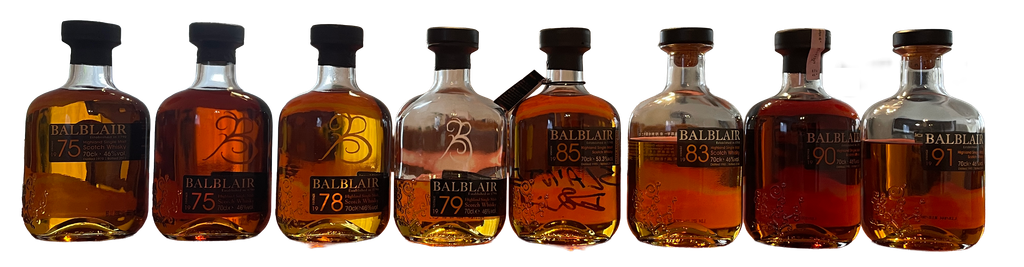
Remember when Balblair was doing single vintages? They were not single casks. (Well, maybe the 85 below was, but anyway.)
And different cask types?
Of course.
This is where the previous article about what refill casks actually mean becomes relevant.
A producer might combine first-fill bourbon, refill bourbon, first-fill sherry and refill sherry casks to achieve a particular balance.
Each brings something different.
And, as we saw in the refill-cask article, even two casks with apparently identical descriptions can behave very differently depending on their history.
A first-fill sherry cask isn’t automatically better than a refill one.
A refill bourbon hogshead isn’t necessarily neutral.
And a cask’s previous contents are only part of its story.
The whisky maker has to work with the actual whisky in those casks, not merely their descriptions on an inventory spreadsheet.
This is also why a recipe expressed as percentages of cask types tells us less than we might assume.
A vatting containing 70% bourbon-cask whisky and 30% sherry-cask whisky could taste dramatically different depending on the individual casks selected.
Thirty per cent of very active first-fill sherry whisky isn’t necessarily equivalent to thirty per cent from tired refill sherry casks.
And those differences are precisely what makes assembling a consistent single malt difficult.
Consistency is a blending achievement.
Here’s something that deserves more recognition.
We celebrate single-cask whisky because every cask is different.
We buy different vintages and cask types because we want to explore those differences.
We discuss warehouse positions, wood species, previous fills, fermentation and distillation regimes.
We know that no two casks mature in exactly the same way.
And then we buy a standard single malt and expect it to taste exactly like the previous bottle.
Think about that for a moment.
A producer may have to assemble hundreds of different casks, each with its own character, to create a whisky that tastes recognisably the same from one batch to the next.
That’s not a trivial exercise.
It requires understanding the available stock, selecting complementary components, balancing competing flavours and anticipating how the final vatting will behave.
And the stock changes continuously.
The casks used for this year’s bottling are no longer available next year.
Some parcels become scarcer.
New parcels reach the required age.
The distribution of first-fill and refill casks changes.
Production methods may have evolved.
Yet the producer is expected to deliver something recognisably consistent.
There is a great deal of skill involved.
Consistency isn’t the absence of blending. It is often the result of very good blending.
And yet batch variation still exists.
This is where Springbank provides a useful example.
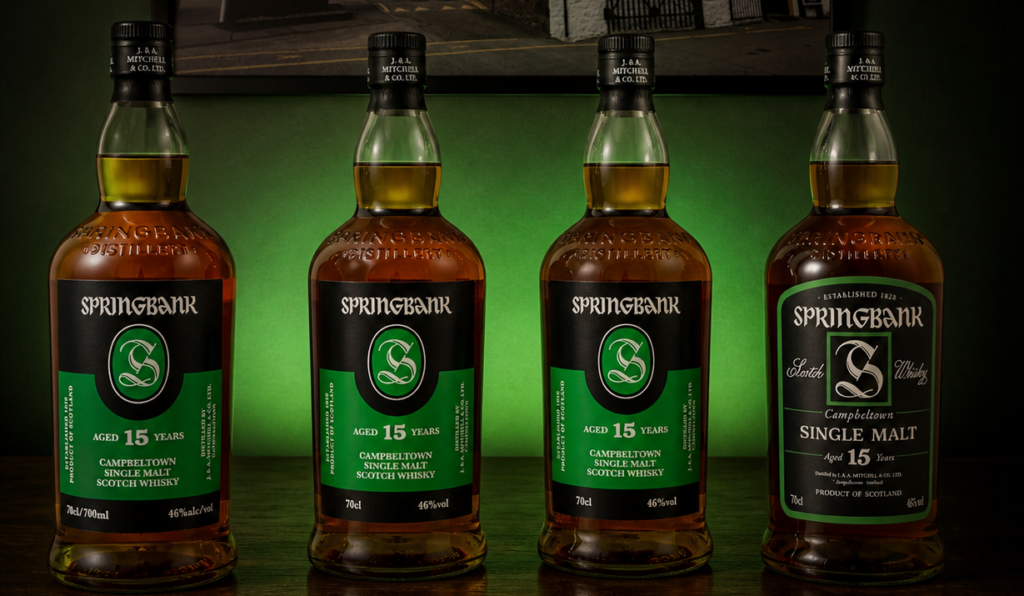
In August 2026, I published a comparison of four Springbank 15-year-olds: an older bottling from around 2006 and the 2024, 2025 and 2026 releases.
The three recent bottles were particularly interesting.
All were 15-year-old single malts.
All were bottled at 46% ABV.
All were matured in sherry casks.
And all were recognisably Springbank.
But they weren’t identical.
The 2024 release was rich and sherried, with dried fruits, chocolate and a characteristic maritime-industrial edge.
The 2025 bottling was rounder and denser, with an almost sherry-bomb character.
The 2026 release was noticeably lighter in its sherry influence, allowing brighter fruits, mineral notes and other aspects of the distillery character to become more prominent.
I even wondered whether the 2026 vatting might have contained a greater proportion of refill sherry casks.
That’s a hypothesis, not a confirmed recipe change.
But it illustrates the point.
Three bottlings with the same name, age statement, strength and broad cask description.
Three different vattings.
Three slightly different results.
And none of them had stopped being Springbank 15-year-old.
You can read the full comparison here: 4 Springbank 15-Year-Old and Batch Variation..
I won’t repeat the whole batch-variation discussion here because that article already covers it.
But it demonstrates why the ability to assemble a consistent vatting matters – and why consistency can never be taken entirely for granted.
Does a single malt have a recipe?
Yes.
Although perhaps not in the sense that a recipe specifies exactly 200 grams of flour and three eggs.
A whisky maker may work towards a particular flavour profile using target proportions of different cask types, ages and other characteristics.
For example, an expression might generally be constructed from a particular balance of bourbon and sherry casks. But that doesn’t necessarily mean the same proportions are used for every batch. Nor does it mean that the individual casks contribute identically from year to year.
A producer may adjust the composition to achieve the intended character. Sometimes those adjustments are relatively small. Sometimes the recipe changes more substantially. And sometimes the distillery deliberately allows noticeable variation between batches.
There is no single industry-wide philosophy.
Some producers prioritise extremely close consistency. Others accept more variation as part of the product’s identity.
Neither approach is automatically superior.
But it does raise an interesting question:
If every cask is different, how much variation should we accept before a familiar whisky stops tasting like itself?
That’s ultimately a question of house style, consumer expectations and the producer’s choices.
Not a question answered by the words single malt.
So what makes a single cask different?
Now let’s move to the other half of the title.
Single-cask whisky is often presented as the purest expression of a distillery.
One cask.
One individual maturation.
No vatting.
No blending.
Just whisky, straight from the wood.
And there is certainly something appealing about that.
A single cask can reveal a particular combination of spirit, oak, maturation conditions and time without the balancing influence of other casks.
It may be magnificent.
It may be unusual.
It may be completely unrepresentative of the distillery’s normal style.
Which is often precisely why independent bottlings are interesting.
But the term single cask deserves the same scrutiny we’ve just applied to single malt.
Because it answers a different question.
And it doesn’t necessarily answer every question we might want to ask.
Single cask isn’t a sixth legal category.
The Scotch Whisky Regulations establish five categories of Scotch whisky.
Single Malt.
Single Grain.
Blended Malt.
Blended Grain.
Blended Scotch.
There is no sixth category called Single Cask Scotch Whisky.
That doesn’t mean bottlers can use the expression however they please. General requirements against misleading descriptions still apply.
But single cask is a description of the whisky’s cask provenance, not a separate statutory category equivalent to Single Malt or Blended Malt.
Consequently, a bottle can be both:
Single Cask
and
Single Malt Scotch Whisky.
Or:
Single Cask
and
Blended Malt Scotch Whisky.
Which sounds contradictory until we remember that the two descriptions answer different questions.
One concerns the cask from which the whisky was bottled.
The other concerns the distilleries from which its component whisky originated.
One cask doesn’t necessarily mean one distillery.
We’ve already encountered this in the article about the language of undisclosed whisky.
My Swell de Spirits Secret Islay is a particularly useful example.

It was bottled from a single hogshead, with an outturn of 432 bottles.
But the label identifies it as:
Blended Malt Scotch Whisky.
According to the bottler, the whisky had been teaspooned.
In other words, malt whisky from another distillery had been added.
The amount may have been extremely small.
The character of the whisky may still have been overwhelmingly determined by the original distillery.
But legally, it was no longer a single malt.
And yet it could still come from one cask.
Single cask does not automatically mean single malt.
That is probably the most important distinction in this entire section.
A cask is a container.
A distillery is a place of production.
They aren’t interchangeable concepts.
A single cask can contain a vatting.
Let’s make the situation slightly more provocative.
Imagine a bottler has whisky from two distilleries.
The whiskies are combined and placed into one oak cask.
They mature together.
Eventually, the bottler empties that cask and bottles its contents.
What do we have?
A blended malt, assuming both components are Single Malt Scotch Whiskies from different distilleries.
And potentially a single-cask bottling, depending on the provenance and how accurately the presentation describes it.
The fact that the whisky occupied one cask does not erase the fact that its components came from two distilleries.
Similarly, the whisky in a single cask need not have been distilled in one batch.
Nor must it necessarily have spent its entire maturation life in that particular cask.
Which brings us to another complication.
What if the whisky was reracked?
Suppose a distillery fills a bourbon barrel with new make spirit.
After ten years, the whisky is transferred into a sherry hogshead.
It spends another five years there.
The bottler then releases the whisky as a single cask.
Is that misleading?
Not necessarily.
The whisky may have been matured in two different casks sequentially, but the final bottling can still come entirely from one individual cask.
However, the words single cask alone do not tell us whether the whisky spent its entire life in that cask.
That’s why additional descriptions such as fully matured, finished or reracked can be useful.
And it is another reason why I dislike assuming that single cask automatically means a simple, uninterrupted maturation history.
A whisky can have a complicated cask biography while still being bottled from one cask.
The important thing is that the description must not mislead consumers about what actually happened.
What about splitting a cask?
Here’s another situation.
A distillery fills one large sherry butt.
After several years, the contents are divided between two smaller casks for further maturation.
Eventually, one of those smaller casks is bottled.
Can the result be described as single cask?
The final whisky may indeed have come from one cask.
But it clearly hasn’t spent its entire maturation life in one cask.
And it shares part of its history with whisky now maturing elsewhere.
That doesn’t automatically make the whisky inferior or the bottling illegitimate.
It simply means that single cask is not necessarily synonymous with a unique, uninterrupted journey from new make to bottle.
The exact wording and context matter.
A description that accurately explains the cask history is more informative than one that relies on the romantic image of a single barrel sitting undisturbed for decades.
Does single cask mean cask strength?
No.
And this one should be straightforward.
A single-cask whisky can be reduced with water before bottling.
Single cask describes the cask provenance.
Cask strength describes something different: how the alcoholic strength has been handled after maturation.
The Scotch Whisky Product Specification constrains the use of cask strength, requiring that the alcoholic strength not be adjusted after maturation.
But there is no rule requiring a single-cask whisky to be bottled at cask strength.
So a single-cask whisky bottled at 46% may be perfectly legitimate.
Likewise, a cask-strength whisky may have been assembled from multiple casks.
Single cask and cask strength are independent claims.
One tells you about the source of the whisky.
The other tells you about its strength.
And neither automatically tells you whether it tastes good.
Does single cask mean natural colour?
Again, no.
Nor does it automatically mean non-chill-filtered.
Those are separate production and bottling choices.
A bottler can choose to release a single cask without colouring or chill filtration.
Many independent bottlers do.
But we shouldn’t treat those characteristics as legally implied by the words single cask.
The same applies to single malt.
Single Malt Scotch Whisky may legally contain plain caramel colouring.
It may be chill-filtered.
It may be reduced to 40% ABV.
And it remains Single Malt Scotch Whisky.
This is another point already touched on in How to Read an Independent-Bottler Label, where the distinction between legally defined categories and voluntary bottling information becomes particularly useful.
One description does not automatically establish another.
Is single cask necessarily more authentic?
Now we’re entering dangerous territory.
Because whisky enthusiasts, myself included, can be rather susceptible to the romance of single casks.
A cask number.
A precise distillation date.
A precise bottling date.
A small outturn.
A strength of 57.3%.
No colouring.
No chill filtration.
Perhaps even the name of the warehouse.
It feels wonderfully direct.
Almost as though we’ve bypassed the entire whisky industry and taken a sample straight from the cask ourselves.
But single cask is not synonymous with quality.
It is a production and bottling choice.
Some casks are extraordinary.
Some are perfectly ordinary.
Some are unbalanced, overly woody, excessively sulphury or simply not particularly interesting.
A vatting allows a whisky maker to combine strengths and compensate for weaknesses.
A single cask exposes whatever happens to be there.
That can be its greatest virtue.
It can also be its greatest limitation.
And there’s another point worth making.
A single cask isn’t necessarily a more representative expression of its distillery.
Quite the opposite.
It may be fascinating precisely because it is atypical.
A heavily sherried, unusually peated or exceptionally fruity single cask may tell us a great deal about that particular maturation.
It may tell us relatively little about the distillery’s usual house style.
A vatting can be better than its components.
This is where I think the single-cask-versus-vatting debate becomes most interesting.
There is a tendency to imagine that combining casks dilutes individuality.
Sometimes it does.
But combining whiskies can also create something that none of the individual casks could deliver alone.
A particularly fruity cask may lack structure.
A more tannic cask may provide that structure but be too drying on its own.
A refill cask may contribute freshness and distillery character.
A sherry cask may add richness.
A small amount of older whisky may bring depth.
The whisky maker can combine those characteristics into something more balanced and complex.
That isn’t necessarily a compromise.
It can be the point.
Of course, a vatting can also be bland.
A producer can prioritise consistency so heavily that unusual characteristics disappear.
But we shouldn’t assume that combining casks inevitably produces something less interesting.
Sometimes the whole really is better than the individual parts.
And sometimes the individual parts are better.
That’s why we taste them.
The irony of single malt.
So here’s the irony.
The whisky industry has spent decades encouraging consumers to regard single malt as something fundamentally more individual than blended whisky.
Yet the creation of a standard single malt may involve an extraordinarily sophisticated blending process.
Meanwhile, a single-cask whisky may contain malt from more than one distillery, may have been reracked, and may have undergone several stages of maturation.
None of this makes the terminology meaningless.
It simply means we need to understand what each term actually describes.
Single malt tells us about the distillery of origin and the method of production.
Single cask tells us about cask provenance, although the complete maturation history may require further explanation.
Single vintage tells us that the whisky was distilled in one calendar year.
Cask strength tells us something about alcoholic strength after maturation.
Natural colour and non-chill-filtered describe other bottling choices.
They are different pieces of information.
They can overlap.
But they aren’t synonyms.
So why do we still care about single casks?
Because they can be wonderful.
Because they allow us to explore whisky in ways that standard bottlings often cannot.
Because a single cask can reveal a distillery’s character under unusual maturation conditions.
Because independent bottlers sometimes release whiskies that official producers would never consider suitable for their core ranges.
And because there is something undeniably appealing about knowing that a particular whisky came from one individual cask, with its own history and peculiarities.
But that doesn’t make it inherently superior to a well-constructed vatting.
Nor does it make the vatting somehow less authentic.
Both are legitimate expressions of whisky-making skill.
One celebrates individuality.
The other can celebrate composition.
And sometimes the most impressive achievement isn’t finding one extraordinary cask.
It’s combining dozens of ordinary and extraordinary casks into something better than any of them could have been alone.
Too long, didn’t read
(Apparently, ‘single’ doesn’t mean short either.)
Single Malt Scotch Whisky means whisky distilled at one distillery, from water and malted barley, in pot stills.
It does not mean one cask, one batch, one vintage or one age.
A single malt can be assembled from numerous casks of different ages and types.
Its age statement refers to the youngest whisky in the vatting.
If a distillation year is stated, all the whisky must have been distilled during that calendar year.
Vatting is the combining of whiskies. Marrying generally refers to allowing combined whisky to integrate before bottling. Blending is the broader process, but in Scotch it also appears in the names of specific legal categories.
A single malt can, therefore, be a blend in the ordinary sense without legally being Blended Scotch Whisky.
Single Cask is not a sixth legal Scotch whisky category.
A single-cask bottling can be a single malt, but it can also be a blended malt or even a blended scotch if whisky from more than one distillery is involved.
Nor does single cask automatically mean cask strength, natural colour, non-chill-filtered or uninterrupted maturation in one cask from beginning to end.
And perhaps most importantly:
Single cask doesn’t mean better.
A great single cask can be extraordinary.
A great vatting can be extraordinary too.
They simply achieve different things.
Conclusion: perhaps we should stop being afraid of blending.
I find it slightly strange that blending became a word from which single malt sometimes seems desperate to distance itself.
Because combining different whiskies is one of the fundamental skills of the industry.
A standard single malt isn’t necessarily a lesser expression because it contains whisky from hundreds of casks.
It may be a remarkable achievement precisely because it does.
And a single-cask bottling isn’t necessarily more authentic because it hasn’t been combined with other casks before bottling.
It may simply be more individual.
Which isn’t quite the same thing as better.
So perhaps the next time someone tells you they don’t drink blends, only single malts, you could ask them how many casks went into their favourite 12-year-old.
Then watch them try to explain why that somehow doesn’t count.
Just don’t expect to be invited to the next tasting.