Oak, demijohns, age accounts and the surprisingly complicated lives of very old eaux-de-vie.
Imagine two Cognacs made from grapes harvested in 1950 and bottled in 2025.
The first was distilled during the 1950–1951 distillation campaign, spent approximately thirty years in oak and was transferred to a glass demijohn around 1980. The second, produced during the same campaign, remained in oak until shortly before bottling.
Both come from the 1950 harvest. Both were bottled seventy-five years after that harvest. And both might be described, at least conversationally, as seventy-five-year-old Cognacs.
But are they really the same age?
In terms of the time elapsed since the harvest, yes. In terms of oak maturation, absolutely not. And in terms of how they taste, there’s no guarantee that the second will be more mature, more complex or even better.
This is one of the most interesting peculiarities of very old Cognac. We tend to treat age as a simple number, when it can describe several quite different things. And to complicate matters further, the year displayed on a Cognac bottle isn’t necessarily the year the eau-de-vie was distilled.
So when does a Cognac actually stop ageing? When it leaves the cask? When it enters a demijohn? When it is bottled? Or does it never completely stop changing?
The answer depends on what we mean by ageing.
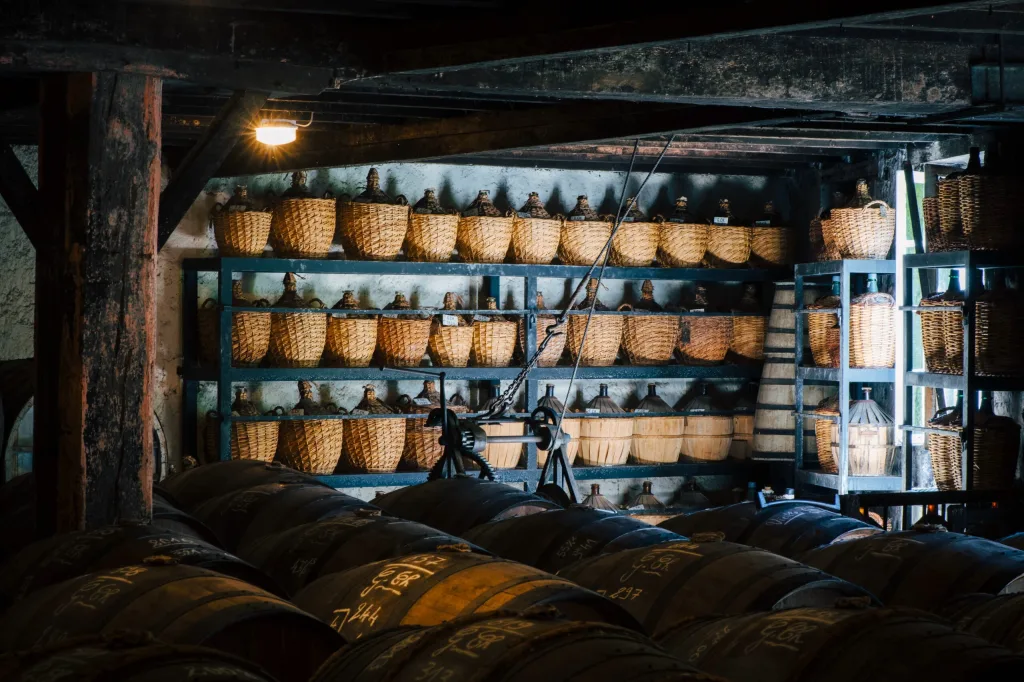
First, what do we mean by ageing?
We use the word ageing rather casually when discussing spirits. A whisky spends twenty years in a cask, so we call it twenty years old. If a Cognac carries a 1975 vintage, we instinctively subtract 1975 from the current year.
But several different concepts are hiding behind that apparently simple calculation.
Chronological age is the time elapsed since a particular event, such as the harvest, distillation or filling of a cask. Those events don’t necessarily happen in the same calendar year.
Oak-maturation time is the period during which the eau-de-vie is aged in oak under the conditions required for Cognac maturation.
Regulatory age is the age recognised under the applicable rules and the ageing-account system.
And sensory maturity is our judgement of how successfully the spirit has developed. It isn’t something that can be calculated from a date.
These concepts often overlap, but they aren’t interchangeable. A Cognac associated with a harvest seventy years ago might have spent only thirty years in oak. Another might have remained in oak for sixty years yet taste excessively woody, while a younger example could offer a more harmonious balance.
That’s why I find the question of when Cognac stops ageing much more interesting than simply asking how old a bottle is.
A Cognac vintage is generally a harvest year.
Before discussing maturation, we need to clear up something that is surprisingly easy to overlook.
In Cognac, a vintage or millésime identifies the year of the grape harvest. It doesn’t necessarily identify the calendar year in which distillation took place.
Cognac is produced from wine, and the grapes are harvested before fermentation and distillation. The distillation campaign begins after the harvest and must be completed by 31 March of the following year.
For example, grapes harvested in September 1975 might produce wine distilled in November 1975. But wine from that same harvest could also be distilled in February 1976.
Both eaux-de-vie belong to the 1975 harvest, even though they were distilled in different calendar years.
This distinction becomes especially important when discussing old Cognac. A bottle marked 1975 shouldn’t automatically be described as having been distilled in 1975. Unless the producer confirms the actual distillation date, the more accurate description is 1975 vintage, 1975 harvest or eau-de-vie from the 1975 harvest.
And then there are lot numbers.
A designation such as Lot 75, L75 or N°75 may be used by a producer or independent bottler to refer to a harvest year. But lot-number conventions are not universal, and such a designation shouldn’t automatically be treated as a certified vintage or proof of a particular distillation date.
Sometimes the year is obvious. Sometimes it is deliberately suggested rather than stated. And sometimes the number means something else entirely.
As usual, the best approach is to ask what the producer can actually document.
What actually happens inside the cask?
Oak maturation is not simply a matter of extracting flavour from wood. Several processes operate simultaneously, and their relative importance changes over time.
The eau-de-vie extracts compounds from oak, including substances derived from lignin, hemicellulose and other wood components. These contribute to colour, aroma, taste and mouthfeel. Vanillin, oak lactones and various phenolic compounds are familiar examples, although their concentrations and sensory contributions depend on the wood and its treatment.
At the same time, chemical reactions occur within the liquid. Some compounds are transformed, others are formed, and the balance between existing substances evolves. Oxygen can participate in these reactions, but oxidation is only part of the story.
Then there is evaporation. Water, ethanol and other volatile compounds can be lost through the cask, gradually changing both the volume and composition of the remaining spirit.
All of these processes interact. The resulting Cognac is not simply the original eau-de-vie plus a certain quantity of oak flavour.
It is a chemically evolving mixture.
And the rate of that evolution is not constant.
A cask doesn’t behave the same way forever.
A newly filled cask can be considerably more active than one that has already held eau-de-vie for decades.
Fresh oak contains readily extractable compounds. Depending on its preparation, it may contribute substantial colour, tannins, woody aromas and other characteristics relatively quickly. As the cask is used, some of those extractable compounds become depleted.
But that doesn’t mean an old cask becomes completely inactive. Evaporation and chemical reactions can continue, while some wood compounds remain available.
This is why Cognac producers may move eaux-de-vie between casks during maturation. An initial period in more active wood can be followed by years or decades in older casks, where the balance between extraction and other maturation processes is different.
The objective isn’t necessarily to extract as much wood character as possible. Quite the opposite. A cellar master may want to preserve the original fruitiness, develop complexity and avoid overwhelming the eau-de-vie with tannins or excessive oak influence.
And that brings us to an important question:
Can a Cognac spend too long in oak?
When more ageing becomes too much ageing.
Absolutely.
There’s a romantic idea that Cognac becomes progressively better the longer it remains in a cask. Ten years is good, twenty is better, fifty is exceptional, and a hundred must surely be the ultimate achievement.
Unfortunately, oak doesn’t work like a loyalty programme.
Extended maturation can produce remarkable complexity, but it can also create problems. The spirit may become excessively tannic, bitter, drying or dominated by wood-derived characteristics. Fruit and floral notes may become less prominent, while the overall balance can deteriorate.
The precise outcome depends on the original eau-de-vie, cask, cellar and maturation history.
A relatively active cask might overwhelm one Cognac after a few decades. Another eau-de-vie, held in older wood under different conditions, may retain extraordinary freshness after a much longer period.
There is no universal age at which Cognac becomes over-oaked. And there is no guarantee that the point of maximum sensory maturity corresponds to the greatest possible number of years in wood.
Sometimes the most important decision a cellar master makes is knowing when to stop.
Enter the dame-jeanne
In Cognac, mature eaux-de-vie are sometimes transferred from oak casks into large glass containers known as dames-jeannes, or demijohns.
These may be protected by wicker baskets or other coverings and stored in the cellars traditionally known as paradis, where houses preserve some of their oldest and most precious stocks.
The purpose is straightforward: to preserve an eau-de-vie that the cellar master considers sufficiently mature, rather than continue exposing it to the same oak-maturation conditions.
Glass is very different from oak. It doesn’t provide the same supply of extractable wood compounds, and an appropriately sealed glass container greatly reduces the exchange of gases and the evaporation associated with a wooden cask.
So the principal processes of oak maturation are interrupted. The eau-de-vie is no longer developing in the same way.
This is why producers commonly describe the transfer to glass as stopping the ageing process.
But is that strictly true from a chemical perspective?
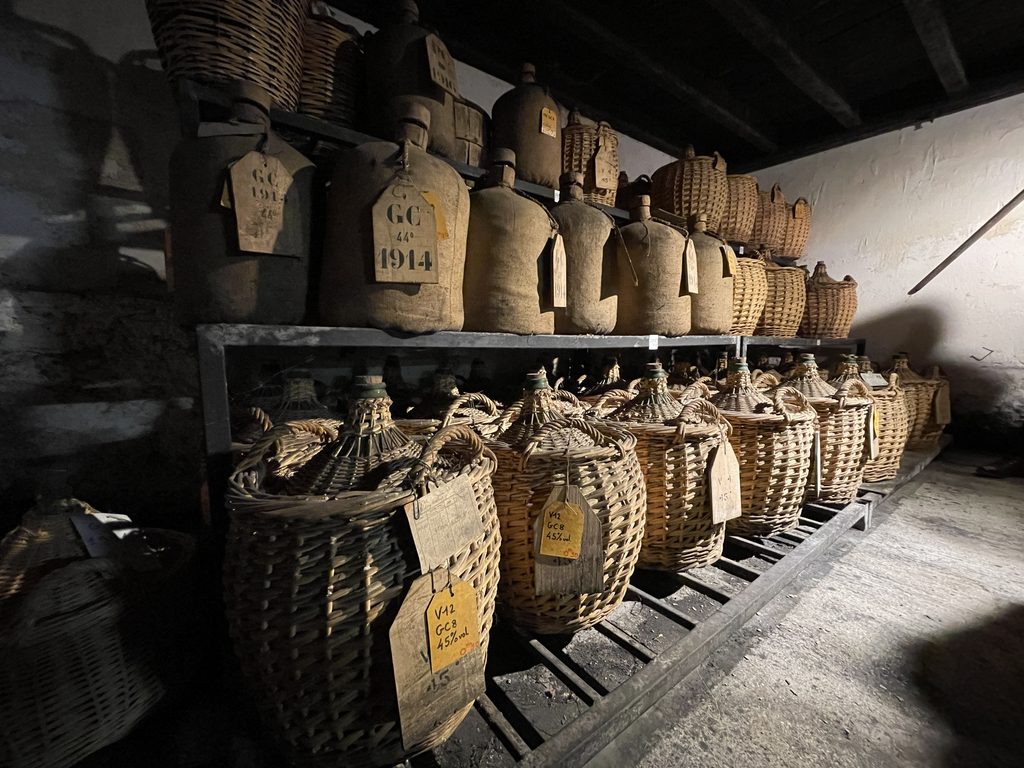
Does Cognac really stop changing in glass?
This is where I would distinguish the practical language of the cellar from the language of chemistry.
When a producer says that ageing stops in a demijohn, the statement is perfectly understandable. The eau-de-vie is no longer maturing in oak, and its regulatory maturation age does not continue increasing merely because it remains in glass.
But saying that the liquid becomes chemically frozen forever would be a much stronger claim.
Glass itself is relatively inert, but the Cognac inside it is still a mixture of chemical compounds. Some reactions may continue, although under very different conditions and often much more slowly than during oak maturation.
The amount of oxygen initially present, the headspace, the closure, temperature and storage duration can all matter. An imperfect seal may also allow exchanges with the outside environment.
This doesn’t mean that a Cognac stored in glass for fifty years undergoes another fifty years of maturation equivalent to time in oak. It doesn’t.
It means that stopping oak maturation and stopping every possible chemical change are not quite the same thing.
That distinction may seem pedantic, but it becomes important when discussing exceptionally old Cognacs. Glass storage is intended to preserve a particular state of maturity, not to provide another, equivalent stage of ageing.
The paradox of the paradis.
There’s something rather fascinating about the traditional Cognac paradis.
It is where producers may preserve their oldest and most valuable eaux-de-vie. Yet, in many cases, the purpose of placing them there is precisely to prevent further oak maturation.
Consider an eau-de-vie from the 1930 harvest, distilled in early 1931 and transferred to glass around 1970. It would have spent approximately thirty-nine years in oak before being preserved in a demijohn.
If bottled in 2025, it would have spent another fifty-five years in glass.
The bottle could legitimately be associated with the 1930 vintage, assuming the appropriate vintage requirements and documentation are satisfied. But describing it as having undergone ninety-five years of oak maturation would be wrong.
And this isn’t necessarily a disadvantage.
The decision to transfer a Cognac to glass may be what preserved its balance, freshness and complexity. Had it remained in oak for another half-century, it might have become less enjoyable.
So the most remarkable thing about a very old Cognac isn’t always how long it remained in wood.
Sometimes it’s that somebody recognised the right moment to take it out.
How does Cognac’s official age calculation actually work?
Now for the regulatory side, because Cognac has a particularly interesting system.
The BNIC maintains ageing accounts known as comptes d’âge. These are used to track stocks and substantiate the age of Cognac.
Unlike a simple anniversary calculation, the system follows a common calendar linked to the harvest and distillation campaign.
Let’s take grapes harvested in 2024.
The wine is produced after the harvest, and the resulting eau-de-vie must be distilled no later than 31 March 2025. Whether distillation takes place in November 2024 or March 2025, the eau-de-vie belongs to the same production campaign.
During distillation, it enters compte 00, the distillation account.
On 1 April 2025, the eaux-de-vie from that campaign enter compte 0 under the ageing-account system.
Then, on each subsequent 1 April, the eligible stock advances to the next account, provided the ageing requirements continue to be met.
The progression looks like this:
| Date | Account | Meaning |
|---|---|---|
| Harvest 2024 to 31 March 2025 | Compte 00 | Distillation campaign |
| 1 April 2025 | Compte 0 | Start of the common ageing-account calendar |
| 1 April 2026 | Compte 1 | First ageing-account anniversary |
| 1 April 2027 | Compte 2 | VS minimum |
| 1 April 2029 | Compte 4 | VSOP minimum |
| 1 April 2031 | Compte 6 | Napoléon minimum |
| 1 April 2035 | Compte 10 | XO minimum |
This is the important distinction: the official ageing account is based on the Cognac ageing calendar, not simply on the exact date when each eau-de-vie was distilled.
Two eaux-de-vie from the 2024 harvest, one distilled in November 2024 and another in March 2025, can advance through the same ageing accounts even though their actual dates of production differ by several months.
The account provides a common regulatory basis for age classification. It doesn’t tell us the precise number of days each individual eau-de-vie has spent in a particular cask.
And entering a higher account isn’t a substitute for satisfying the relevant maturation requirements. Cognac ageing must take place under the prescribed conditions in oak, and time spent in glass doesn’t simply add further years of recognised oak maturation.
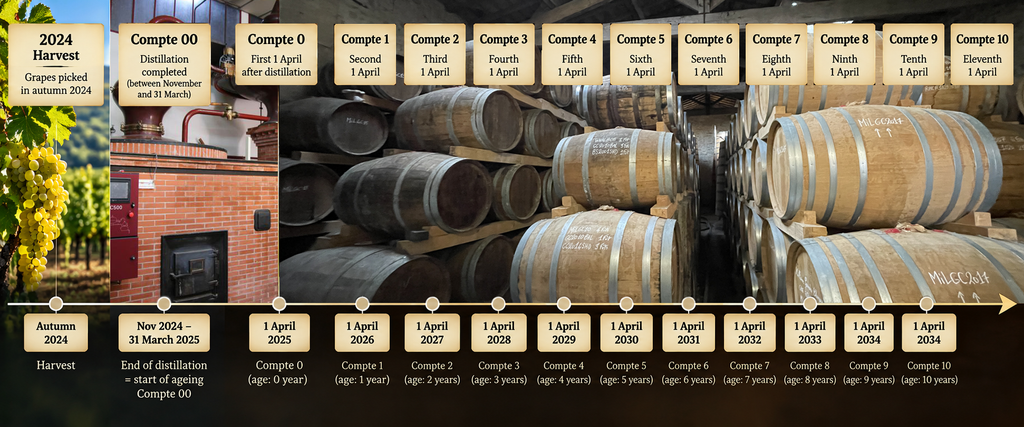
Why isn’t compte 0 already one year old?
This is a source of understandable confusion.
The grapes may have been harvested months before the eau-de-vie enters compte 0. Some of the wine may have been distilled several months earlier, while another portion may have been distilled shortly before the March deadline.
But the official system does not award an entire year of maturation merely because the harvest took place in the previous calendar year.
Instead, 1 April following the harvest establishes the common reference point. The first advancement to compte 1 occurs on 1 April of the following year.
For the 2024 harvest, that’s 1 April 2026.
And compte 2 is reached on 1 April 2027, making the eau-de-vie eligible for the VS age category, provided all other requirements are met.
This is why you shouldn’t calculate the regulatory age of Cognac by simply subtracting the harvest year from the current year.
In October 2026, an eau-de-vie from the 2024 harvest is not automatically a two-year-old Cognac for labelling purposes. Under the standard account calendar, it is still in compte 1.
The date matters.
And what about blends?
Most Cognac is blended from several eaux-de-vie, sometimes from different harvests, crus and maturation histories.
The age designation is determined by the youngest eau-de-vie in the blend.
A Cognac containing forty-year-old, twenty-year-old and six-year-old eaux-de-vie cannot be labelled XO simply because most of the liquid is much older. Its youngest component determines which minimum-age category it qualifies for.
Under the usual classifications, VS requires compte 2, VSOP compte 4, Napoléon compte 6 and XO compte 10. XXO requires at least fourteen years of recognised ageing, supported by the appropriate documentation.
This doesn’t mean that all the components of an XO are exactly ten years old. Some may be substantially older.
Nor does it mean that a producer must bottle an eau-de-vie as soon as it reaches a particular account.
The age categories establish minimum requirements, not ideal maturation periods.
What happens after compte 10?
The standard BNIC ageing accounts run through compte 10, but that doesn’t mean Cognac stops ageing after ten years.
Nor does it mean that a twenty-, fifty- or seventy-year-old Cognac is impossible to document.
Compte 10 is the highest account in the standard progression. Stocks older than that may require additional supporting records and verification for more precise age claims, rather than relying on an ordinary account number alone.
For example, XXO has a minimum age of fourteen years, even though the standard sequence of ageing accounts doesn’t extend to a separate compte 14.
And when a producer claims that an eau-de-vie has spent fifty years in oak, the evidence must support that maturation history.
The absence of a compte 50 doesn’t make the claim impossible.
It means that the standard ageing-account number and the documented history of an exceptionally old eau-de-vie are not the same thing.
A harvest year is not an oak-age statement.
We’ve already touched on this in the article about decoding Cognac labels, so I won’t repeat the whole discussion of vintages and lot numbers.
But it matters enormously here.
Imagine a Cognac from the 1975 harvest. The wine was distilled in February 1976, the eau-de-vie remained in oak until 2000, and it was then transferred to a demijohn before being bottled in 2025.
The bottle could be associated with the 1975 vintage. It was distilled in 1976 and bottled fifty years after the harvest.
But its time in oak was approximately twenty-four years.
Now compare that with another Cognac from the same 1975 harvest, distilled in late 1975 and kept in oak until 2025.
Both may share a legitimate 1975 vintage identity, but their maturation histories are very different.
This distinction is even more important when a producer or independent bottler uses a lot number instead of an explicit vintage.
If Lot 75 refers to the 1975 harvest, it doesn’t necessarily mean distillation took place in 1975. And it certainly doesn’t tell us when the eau-de-vie left the cask.
A harvest year, distillation date, transfer-to-glass date and bottling date are four separate pieces of information.
For an exceptionally old Cognac, I would love to know all four.
What about a 100-year-old Cognac?
This is where things become particularly interesting.
A Cognac associated with the 1924 harvest and bottled in 2024 spans a century of history.
But what does that actually tell us?
The grapes were harvested in 1924. Distillation might have taken place in late 1924 or early 1925. The resulting eau-de-vie could have remained in oak for several decades before being transferred to glass, or it could have followed a much longer maturation history.
Without the appropriate documentation, we cannot simply infer the answer from the two years.
My Famille Cabanne Lot 24, associated with the 1924 harvest and bottled in 2024, is an excellent example of why these distinctions matter.
The designation Lot 24 should be understood in light of the producer’s information about the harvest and production history, rather than automatically interpreted as a precise distillation date.
And the century between the harvest and bottling should not automatically be presented as a full hundred years of oak maturation. Even though, in the Famille Cabanne Lot 24’s case, it was indeed a full hundred years of oak maturation.
This doesn’t diminish the significance of the Cognac. If anything, it makes its history more interesting.
A century-old eau-de-vie isn’t remarkable only because of the time elapsed. It is remarkable because it survived decades of decisions about storage, maturation and preservation before finally reaching the bottle.
Can we really know the history of very old Cognac?
Sometimes, yes. Sometimes only partially.
Modern stock management, traceability requirements and age certification provide important safeguards. But when dealing with eaux-de-vie produced many decades ago, historical records can be more complicated.
Stocks may have changed ownership. Casks may have been transferred between cellars. An eau-de-vie may have moved from one barrel to another, been stored in glass or undergone other documented operations.
A specialist bottler may acquire an old parcel with accompanying records. The quality and completeness of that documentation are crucial when establishing what can responsibly be claimed.
This is why I value detailed information from producers and bottlers.
A label stating 1975 is interesting. A producer explaining that the grapes were harvested in 1975, the wine distilled in February 1976, the eau-de-vie transferred to glass in 2005 and bottled in 2025, is considerably more informative.
But we should also distinguish between direct records, historical testimony and assumptions based on a lot designation.
An old Cognac doesn’t become less enjoyable because its history isn’t perfectly documented.
It simply means we should be careful about how confidently we describe that history.
The angel’s share complicates everything.
There is another reason why very long maturation can be difficult: evaporation.
During oak ageing, Cognac gradually loses liquid through the cask. This is the famous part des anges, or angel’s share.
But it isn’t simply a fixed percentage of spirit disappearing every year.
The relative evaporation of water and ethanol depends on several factors, particularly cellar humidity and temperature. In more humid environments, alcoholic strength may tend to decline more rapidly; in drier conditions, the relative loss of water can be greater.
The actual behaviour depends on the conditions, the cask and the composition of the liquid.
Over decades, these changes can become substantial. A Cognac may lose a considerable proportion of its original volume, while its alcoholic strength and concentration evolve.
This creates a practical problem for very old eaux-de-vie.
A spirit that continues losing alcohol may eventually approach or fall below the minimum alcoholic strength required for Cognac sold under the appellation. For ordinary Cognac, that minimum is 40% ABV, subject to the applicable provisions.
The cellar master therefore has more to consider than flavour alone. There is the remaining volume, the alcoholic strength, the condition of the cask and the future of the stock.
Moving a mature eau-de-vie into glass can help protect it from further substantial losses.
Sometimes the decision to stop oak maturation is as much about preserving what remains as it is about perfecting the flavour.
Does old Cognac always become more concentrated?
Not necessarily in the simple way people sometimes imagine.
As water and ethanol evaporate, certain less volatile substances may become more concentrated in the remaining liquid. But other compounds can themselves evaporate, react or be transformed.
Meanwhile, the spirit continues extracting and interacting with wood.
So it would be misleading to describe maturation as a process in which every desirable aroma becomes progressively more concentrated.
Some compounds increase in concentration, some decrease, and others are formed or transformed.
The overall sensory result depends on their balance, not merely their total quantity.
This also helps explain why an extremely old Cognac can sometimes feel remarkably fresh, while another becomes heavy, woody or unbalanced.
Age doesn’t move every component in the same direction.
And more concentration doesn’t automatically mean more complexity.
The role of cellar humidity.
Cognac producers traditionally distinguish between humid and dry cellars.
Humidity influences the relative evaporation of water and ethanol, which in turn affects how alcoholic strength evolves over time.
A humid cellar may favour a reduction in alcoholic strength and a softer profile, while a drier environment can lead to a different balance of losses and a different maturation trajectory.
But I would be cautious about treating those tendencies as absolute rules.
Temperature, airflow, cask size, wood properties and the starting composition of the eau-de-vie all matter.
And we shouldn’t jump from observing differences in evaporation to claiming that one type of cellar necessarily produces better Cognac.
There is no universal ideal humidity that guarantees superior maturation.
A cellar master may deliberately use different environments or move casks to influence how an eau-de-vie develops.
Once again, maturation is not simply a passive process in which the spirit sits in a barrel until somebody decides it is old enough.
It involves choices.
When is a Cognac at its best?
This is perhaps the most difficult question of all.
From a regulatory perspective, we can establish minimum ageing requirements and verify documented histories.
From a chemical perspective, we can measure changes in composition.
But determining when a Cognac is at its best is ultimately a sensory judgement.
One cellar master may decide that an eau-de-vie has reached its ideal balance after twenty-five years. Another might keep a different parcel in oak for fifty years because it continues developing favourably.
Neither decision is necessarily wrong.
The important question isn’t how many years have passed, but what those years have done to the spirit.
Has the fruit remained expressive? Has the oak become integrated? Has the texture improved? Have new layers of complexity emerged? Or has the eau-de-vie begun losing the characteristics that made it interesting?
There is no formula that can answer those questions for every cask.
And that’s precisely why the cellar master’s role matters.
Why some very old Cognacs remain surprisingly fresh.
One of the characteristics I particularly appreciate in old Cognac is the ability to retain freshness despite decades of maturation.
I’ve tasted old eaux-de-vie with extraordinary aromatic complexity that still offered lively fruit, balance and a remarkably engaging mouthfeel.
My Richard Delisle Lot 53 Grande Champagne is one of the finest Cognacs I’ve tasted, while the Famille Cabanne Lot 24 demonstrates how compelling a genuinely historic eau-de-vie can be.
But I wouldn’t use those tasting experiences to establish a general rule about maturation.
A particular Cognac’s freshness might reflect its original distillate, the choice of casks, the cellar environment, the timing of transfers or several interacting factors.
Without detailed records, assigning the result to one cause would be speculation.
What these examples do remind me is that old age and excessive oak influence are not the same thing.
An eau-de-vie can be exceptionally old without tasting tired.
And a much younger one can already be over-oaked.
Is there a point of diminishing returns?
Almost certainly, although it won’t occur at the same age for every eau-de-vie.
Early maturation can bring substantial changes as the spirit interacts with oak. Over time, the relative importance of extraction and other processes changes, and the rate of certain developments may slow.
At some point, further time in wood may add little desirable complexity. In other cases, it may actively damage the balance.
But I would avoid imagining a universal maturation curve where quality rises steadily, reaches a peak at forty years and then declines.
Different compounds evolve at different rates, and different people value different sensory characteristics.
A Cognac that one drinker considers perfectly mature may be too woody for another. A relatively young Cognac that one person finds vibrant and fruity may seem insufficiently developed to somebody who prefers pronounced rancio.
Maturity isn’t a single measurable quantity.
It is a judgement about the balance and character of the finished spirit.
What can science tell us about ageing in glass?
There is an interesting distinction between what we know from oak-maturation research and what we know about long-term glass storage.
Oak maturation has been studied extensively across wine spirits and other alcoholic beverages. Researchers can measure changes in phenolic compounds, volatile aromas, colour and other characteristics.
Glass storage has also been investigated, although studies are not always directly comparable to the decades-long preservation of old Cognac in demijohns.
For example, research published in 2025 examined physicochemical changes in wine spirits during bottle storage following different ageing treatments. It demonstrates that storage after maturation is a legitimate subject for chemical investigation.
But it would be a mistake to take the findings from a relatively short experiment involving a particular wine spirit and assume they describe what happens to every old Cognac stored in a demijohn for half a century.
The vessel, closure, headspace, temperature, previous maturation and duration all matter.
The scientifically defensible position is, therefore, rather less dramatic than either extreme (which goes well with this blog’s name – sorry for the bad pun).
Glass storage is not equivalent to continued oak maturation.
But it is also too simplistic to claim that absolutely no chemical changes can ever occur once an eau-de-vie leaves the cask.
Does Cognac age in the bottle?
Not in the regulatory and practical sense in which we discuss oak maturation.
Once Cognac has been bottled, it no longer accumulates additional years of oak ageing. A Cognac bottled in 1980 does not become forty-six years older in terms of recognised maturation simply because the bottle remained unopened until 2026.
Its maturation history remains what it was at bottling.
However, the contents of an old bottle may change during storage. Closures can deteriorate, evaporation or oxygen ingress may occur, and the aromatic profile can evolve under some conditions.
That is why bottle condition matters when evaluating old bottlings.
A well-preserved bottle and one stored poorly for several decades may offer very different experiences, despite containing the same Cognac when they were filled.
This is closely related to the questions surrounding old Scotch whisky bottlings and so-called Old Bottle Effect.
But once again, we should distinguish between observed sensory differences and scientifically established mechanisms.
An old bottle tasting different doesn’t mean that it continued maturing as though it were still in oak.
So what does a fifty-year-old Cognac actually mean?
It depends on what is being claimed.
If the producer explicitly states that the Cognac underwent fifty years of oak maturation, that is a claim about its maturation history and should be supported by appropriate evidence.
If the bottle identifies a harvest year fifty years before bottling, that establishes a different kind of chronological information.
If a retailer describes a Cognac as fifty years old simply because it carries a fifty-year-old vintage, we should check whether that interpretation reflects the producer’s documentation and the actual period of maturation.
And if the label simply says XO, we know the applicable minimum age category, not the precise ages of every component.
These distinctions aren’t intended to make Cognac unnecessarily complicated.
They help us understand what we’re actually buying, tasting and discussing.
Because the number alone rarely tells the complete story.
Too long, didn’t read.
(It took ages to read until here so, of course, even the ageing process needs a TL;DR.)
A Cognac vintage normally refers to the grape harvest year, not necessarily the distillation year. Distillation may take place during the harvest year or in the first three months of the following year. Lot numbers sometimes refer to harvest years too, but their meaning needs confirmation.
Official Cognac ageing follows a common calendar. Eaux-de-vie from a given harvest campaign enter compte 0 on 1 April following that harvest, then advance through the accounts on subsequent 1 April dates, provided the ageing requirements are met. Compte 2 corresponds to the VS minimum, compte 4 to VSOP, compte 6 to Napoléon and compte 10 to XO.
Chronological age, oak-maturation time and sensory maturity are different things. A Cognac associated with a harvest seventy-five years ago has not necessarily spent seventy-five years in oak.
During maturation, the eau-de-vie undergoes extraction, chemical transformations, oxygen-related reactions and evaporation. These processes don’t all occur at the same rate, and longer maturation doesn’t automatically mean better Cognac.
Glass demijohns are used to preserve mature eaux-de-vie. Moving Cognac into glass stops normal oak maturation, but that doesn’t prove every possible chemical change stops completely.
And perhaps most importantly, the oldest Cognac is not necessarily the most mature, balanced or enjoyable.
Sometimes the decision that makes a great old Cognac possible is knowing when to remove it from the cask.
Conclusion: knowing when to stop.
There’s something rather ironic about very old Cognac.
We admire it for its age, celebrate the decades it has survived and sometimes pay extraordinary prices for the privilege of tasting it.
Yet one of the most important decisions in its history may have been the moment somebody decided it had spent enough time ageing.
Not another ten years.
Not another twenty.
Enough.
That decision might have preserved the fruit, prevented excessive wood influence or protected the remaining liquid from further evaporation. It may have allowed an eau-de-vie to survive for another half-century without losing the qualities that made it exceptional.
And when we eventually taste that Cognac, we’re experiencing the result of all those decisions, not simply the passage of time.
So when does a Cognac stop ageing?
In the regulatory and conventional sense, when its oak maturation ends. In the chemical sense, the answer is more nuanced, because some changes may continue during storage. And in the sensory sense, the most important question is whether the Cognac has reached the point at which further maturation would improve it – or make it worse.
Perhaps that’s the real achievement behind a magnificent old Cognac.
Not keeping it in a cask for as long as possible.
But knowing when it was time to stop.
References and further reading
- French ageing-account rules – Article 6. Sets out the distillation campaign, compte 00, the 1 April transition into compte 0, and annual advancement. Légifrance
BNIC – Ageing accounts and certification. Explains how the BNIC tracks stock movements and certifies origin and age. Cognac.fr
BNIC – Cognac ageing classifications. Covers minimum maturation requirements and the youngest-component rule. Cognac.fr
Cognac specification approved June 2026. The current appellation specification. Légifrance