Sulphur, still shapes, worm tubs and the chemistry behind one of whisky’s most misunderstood ingredients.
Walk into almost any malt whisky distillery and you’ll see those magnificent copper pot stills, often polished to perfection. They’re beautiful, traditional and essential to the character of the whisky. But not necessarily for the reasons you hear during a distillery tour.
Copper isn’t just a convenient material for making stills. It actively influences the chemistry of distillation, particularly the sulphur compounds responsible for aromas ranging from rotten eggs and cabbage to meaty and savoury notes. Without sufficient copper contact, whisky can taste very different.
But if copper removes undesirable sulphur compounds, why don’t distilleries simply maximise copper contact? Why do some deliberately produce heavier, more sulphury spirits? And why can copper sometimes contribute to the formation of sulphur compounds rather than removing them?
Welcome to the copper paradox.
Why copper?
Copper has been used in distillation for centuries. It conducts heat efficiently, can be shaped into elaborate stills and is relatively easy to repair. But its most interesting property is chemical: unlike stainless steel, copper reacts with certain compounds during distillation.
One of its most important roles is reducing undesirable sulphur-related aromas. These can originate from the barley and develop during fermentation and distillation.
Sulphur compounds are not all the same, however. Hydrogen sulphide is associated with rotten eggs, dimethyl sulphide with cooked vegetables, and dimethyl trisulphide with powerful cabbage-like or meaty aromas. Some can be detected at extremely low concentrations.
And not all sulphur-related characteristics are necessarily unpleasant. Depending on the compounds involved and their concentrations, they can contribute to the savoury, robust character of certain whiskies.
So the objective isn’t necessarily to remove every trace of sulphur. It’s to achieve the right balance.
How does copper remove sulphur?
When sulphur-containing compounds encounter copper surfaces, chemical reactions can change their composition or prevent some of them from reaching the collected spirit.
For example, hydrogen sulphide can react with copper-containing surfaces to form copper sulphide compounds. Other sulphur substances undergo different reactions, depending on their chemistry and the distillation conditions.
The result is often a cleaner, less sulphury spirit.
But copper isn’t a filter that simply traps every undesirable molecule. Different compounds react differently, and the temperature, composition of the liquid or vapour, condition of the copper surface and duration of contact all matter.
More importantly, copper can also participate in reactions that produce certain sulphur compounds.
Research has shown that compounds such as dimethyl disulphide can form through copper-associated reactions during distillation. Copper may, therefore, help create some sulphur compounds while reducing others.
This isn’t a contradiction. It simply means the chemistry is more complicated than copper removes sulphur.
The final result depends on which reactions dominate and what eventually reaches the spirit receiver.
Does it matter where the copper is?
Absolutely. And this is one of the most interesting findings from whisky research.
In 2011, Barry Harrison and colleagues at the Scotch Whisky Research Institute published a study examining the influence of copper in different parts of malt whisky pot stills.
They used experimental equipment in which sections could be made from copper or stainless steel, allowing them to investigate the effects of copper contact in different locations.
The results showed that copper could significantly reduce sulphury characteristics, but its effectiveness depended on where the contact occurred.
Copper in the boiler, neck and condenser doesn’t necessarily have the same effect. The liquid and vapour have different compositions and temperatures as they travel through the distillation system, creating different conditions for chemical reactions.
The researchers also found that measuring a single sulphur compound, dimethyl trisulphide (DMTS), couldn’t explain every sensory difference between the spirits.
In other words, it’s not just how much copper there is, but where and how the spirit comes into contact with it.
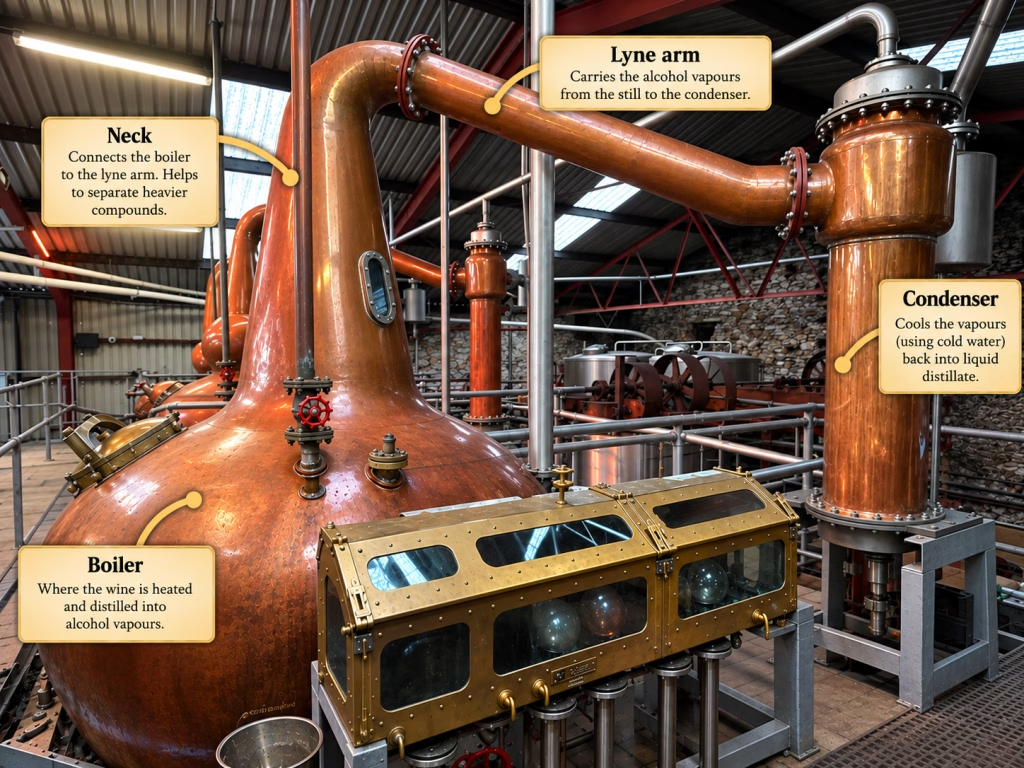
Still shape, reflux and copper contact
Distillery tours often associate tall stills with light, fruity whisky and shorter stills with heavier spirits.
There’s some truth behind those generalisations, but still shape isn’t a magic formula for flavour.
The geometry influences how vapour travels through the still and how much of it condenses before reaching the condenser. This internal condensation is known as reflux.
When vapour condenses and flows back towards the boiler, it can be reheated and vaporised again. This influences which compounds are carried forward during distillation.
It also creates additional opportunities for contact with copper surfaces.
Tall stills, upward-sloping lyne arms and other design features may encourage reflux, but the actual result depends on the equipment and how it’s operated.
And there’s an important distinction: reflux changes the physical separation of compounds, while copper can also change their chemistry.
Both processes influence the spirit, and they often interact.
So when a distillery produces a light, fruity new make, we shouldn’t automatically attribute everything to its tall copper stills. Fermentation, heating rate, distillation cuts and condenser design also contribute.
Worm tubs: less copper contact, more character?
Condensers are another important part of the story.
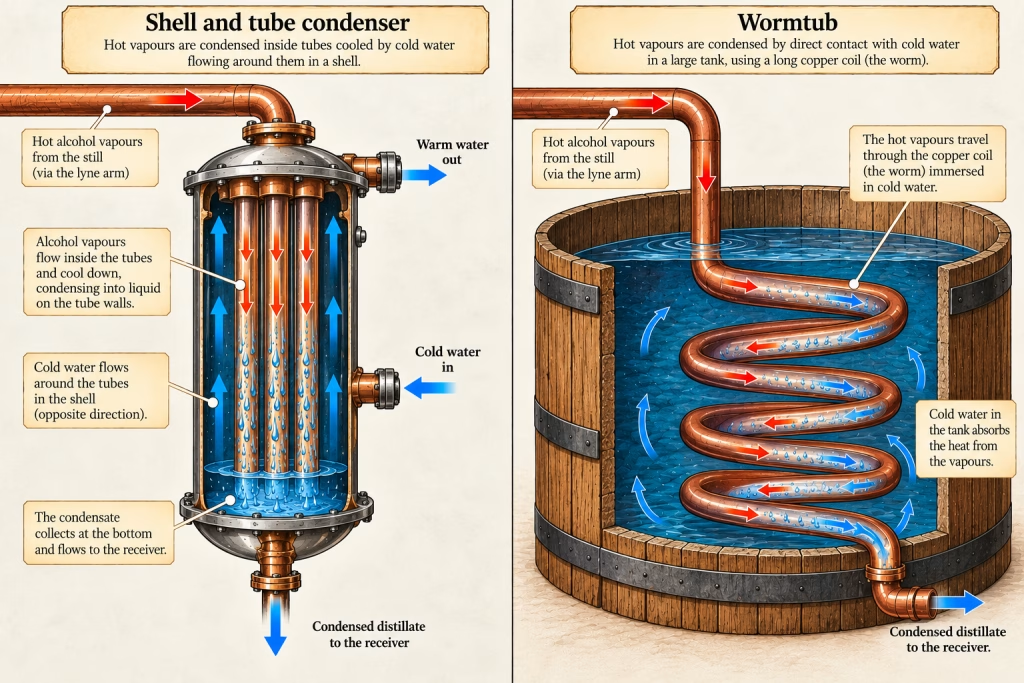
Their job is to cool the vapour leaving the still until it becomes liquid again. Scotch whisky distilleries commonly use either traditional worm tubs or shell-and-tube condensers.
Worm tubs contain a long, coiled copper pipe immersed in cooling water. Vapour passes through the coil and condenses as it travels along it.
Shell-and-tube condensers use multiple tubes and a different arrangement of cooling surfaces. They commonly provide substantial opportunities for copper contact.
Worm tubs are often associated with heavier, meatier and more sulphury spirits, while shell-and-tube condensers are frequently associated with lighter, cleaner styles.
But the explanation isn’t simply that worm tubs contain less copper. They contain plenty of copper too.
What matters is how the vapour and condensate interact with the metal, including temperature, flow and contact time.
The two designs create different conditions for condensation and chemical reactions. Those differences can influence how much of certain sulphur compounds survive into the new make.
However, the condenser design is only one part of the process. It doesn’t determine the entire character of a distillery.
Mortlach and Craigellachie: when sulphur is part of the character.
Two distilleries frequently associated with worm tubs are Mortlach and Craigellachie.
Mortlach is famous for its complex distillation regime, commonly described as 2.81 times distillation (I tried to explain it here), and its substantial, sometimes meaty spirit character.
Craigellachie also produces a relatively robust distillate, often displaying savoury, cereal-driven and occasionally sulphury characteristics.
It’s tempting to attribute these profiles entirely to their worm tubs, but that would be oversimplifying things.
Mortlach’s unusual distillation arrangements, for example, also influence the composition of its new make. Fermentation conditions, still design and distillation cuts matter at both distilleries.
And describing a whisky as meaty doesn’t prove that a particular sulphur compound is responsible for that aroma.
Nevertheless, these distilleries illustrate an important point: not everyone is trying to produce the lightest, cleanest possible spirit.
Some distilleries deliberately preserve a heavier, more robust character.
And that’s a good thing. Whisky would be considerably less interesting if every distillery aimed for the same result.
Why not remove all the sulphur?
Because removing as much sulphur as possible isn’t necessarily the goal.
Some sulphur compounds are clearly undesirable at certain concentrations. Rotten eggs and rubber aren’t usually the first aromas we’re hoping to discover in a whisky.
But other sulphur-associated notes, or very small concentrations of particular compounds, can contribute to a complex sensory profile.
The key is balance.
A distillery producing a light, fruity spirit may benefit from extensive and effective copper contact. Another aiming for a heavier, savoury style may want to preserve more of its distinctive character.
That doesn’t mean sulphur is automatically desirable in the second case. It means that a completely neutral spirit isn’t the objective.
And copper isn’t the only tool involved. Fermentation conditions influence which sulphur compounds are produced in the first place, while distillation cuts affect which compounds are collected.
A distiller can, therefore, influence the sulphur profile through several interacting decisions, not simply by choosing a particular still shape.
What happens to sulphur during maturation?
The sulphur profile of new-make spirit isn’t necessarily the same as that of the finished whisky.
During maturation, some volatile sulphur compounds decrease in concentration or undergo chemical transformations. Research by Masuda and Nishimura in 1982 demonstrated that different sulphur compounds behave differently during whisky ageing.
Some decline relatively quickly, while others change more gradually.
This helps explain why a new-make spirit with noticeable sulphury characteristics can develop into a balanced, complex whisky after years in oak.
But maturation doesn’t guarantee that every unpleasant sulphur note will disappear.
There’s also another complication: not every sulphury aroma in mature whisky originates from distillation.
Certain cask-related problems, including issues associated with the previous treatment or contents of a cask, can introduce or contribute to sulphur-associated characteristics.
So we should distinguish between a naturally robust distillate and a whisky affected by an unpleasant sulphury cask.
They’re not necessarily the same problem, even if some tasting descriptors overlap.
And tasting alone rarely tells us precisely which compounds are responsible.
Can we measure copper’s influence?
Yes, but there isn’t a single number that tells us everything.
Researchers can measure copper surface area, temperatures, flow rates and the concentrations of individual sulphur compounds in the spirit.
However, a large copper surface doesn’t necessarily mean more effective sulphur removal. The position and condition of the surface, the chemical environment and the duration of contact all matter.
This is why the 2011 study by Harrison and colleagues is so useful. By changing specific parts of the equipment while controlling other variables, the researchers could investigate copper’s influence more directly.
Even then, laboratory-scale results don’t automatically translate perfectly to every commercial distillery.
Real distilleries differ in still dimensions, heating systems, fermentation conditions, distillation regimes and condenser designs.
That’s also why we should be cautious about comparing two finished whiskies and attributing their differences entirely to copper contact.
A ten-year-old whisky matured in refill bourbon and a fifteen-year-old whisky from an active sherry cask may taste very different for reasons that have little to do with their stills.
The influence of copper is real, but isolating it requires more than comparing tasting notes.
Too long, didn’t read
(Apparently, even the still needs a TL;DR.)
Copper plays an important role in whisky distillation because it reacts with certain sulphur compounds and can reduce undesirable aromas.
But sulphur compounds aren’t all alike, and some can contribute to a whisky’s distinctive character. Copper can also participate in reactions that form particular sulphur compounds.
Where copper contact occurs matters as much as how much copper is present. Still shape, reflux and condenser design all influence the result.
Worm tubs are often associated with heavier, more sulphury spirits, while shell-and-tube condensers are frequently associated with cleaner styles. But neither the condenser nor the still shape determines the entire character of a whisky.
Fermentation, distillation cuts and maturation also influence sulphur-associated aromas.
And most importantly, more copper contact doesn’t automatically mean better whisky.
Conclusion: the right copper, not the most copper
Copper is one of the most important materials in traditional malt whisky production. Not just because it conducts heat efficiently or because polished copper stills look magnificent in distillery photographs.
It matters because it changes the chemistry of distillation.
But its role is more complicated than simply removing sulphur and making whisky cleaner. Its effects depend on the compounds involved, the location of copper contact and the conditions inside the still.
This helps explain why different distilleries can produce such distinctive new-make spirits, even when using broadly similar raw materials.
Some pursue lightness and fruit. Others embrace weight, savoury notes and a more robust character.
Neither approach is automatically superior.
Personally, I enjoy whiskies where the distillate retains a recognisable identity, whether that’s the bright fruitiness of one distillery or the heavier character of another.
And that’s perhaps the best way to think about copper.
Not as something that simply makes whisky better, but as one of the tools that allows distillers to make whisky different.
References and further reading
- Harrison, B., Fagnen, O., Jack, F. & Brosnan, J. (2011). ‘The Impact of Copper in Different Parts of Malt Whisky Pot Stills on New Make Spirit Composition and Aroma.’ Journal of the Institute of Brewing, 117(1), 106–112. The key experimental study demonstrating how copper contact in different parts of the still affects sulphur compounds and new-make spirit character. Read the full paper (free PDF).
- ‘Chinese Baijiu and Whisky: Research Reservoirs for Flavor and Functional Food’ (2023). A scientific review comparing flavour chemistry in distilled spirits, including copper-related reactions and the formation and transformation of sulphur compounds. Read the full open-access article.
- Douady et al. (2019). ‘Batch Distillation of Spirits: Experimental Study and Simulation of the Behaviour of Volatile Aroma Compounds.’ Journal of the Institute of Brewing. An experimental investigation of copper-pot distillation, useful for understanding the behaviour of volatile aroma compounds and the influence of distillation conditions. This is supporting research rather than a direct study of copper-mediated sulphur removal in Scotch whisky. Read the article.
- Distiller (2018). ‘Shaping Scotch: Whisky Condensers, Old or New School?’ An accessible explanation of worm tubs and shell-and-tube condensers. Read the article.